
Bounce Circuit: Power the Landing, Then Control the Next Jump
Steer across numbered trampolines, reserve three powered rebounds for long gaps and learn why landing preparation matters.
Seven jumps with a plan
Bounce Circuit places a small rider in a floating training park with eight numbered pads and seven jumps to complete. The aim is to land on each trampoline in order and reach the gold finish island. Movement continues through each rebound, so a successful landing is also the beginning of the next decision. You need to consider both where you are descending and how far the following jump must travel.
The current game contains 24 challenges. Shorter and longer gaps alternate along the course, while the pad positions introduce sideways alignment. Later challenges use smaller trampoline radii than the earliest set. The route remains readable, but simply holding forward does not guarantee a clean circuit: a useful trajectory must put the rider over the next pad as the jump comes down.
Steer in flight, power at contact
Press GO or G to start. Hold the arrow keys or WASD to steer in the air. On touch screens, use the directional controls and POWER together when needed. Steering changes your movement during the jump, allowing you to correct the approach to the next numbered trampoline. Watch the target pad rather than treating the entire park as one straight runway.
POWER or Space has a precise role: hold it when landing to spend a charge and produce a higher rebound. Pressing it in midair does not launch another jump. This distinction matters because the charge is preparing the departure from the pad you are about to land on. If you wait until you are already crossing the long gap, you have missed the useful moment.
Read the next gap before landing
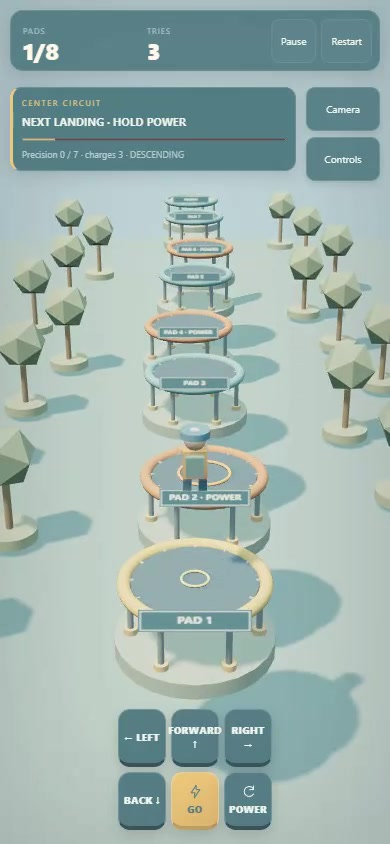
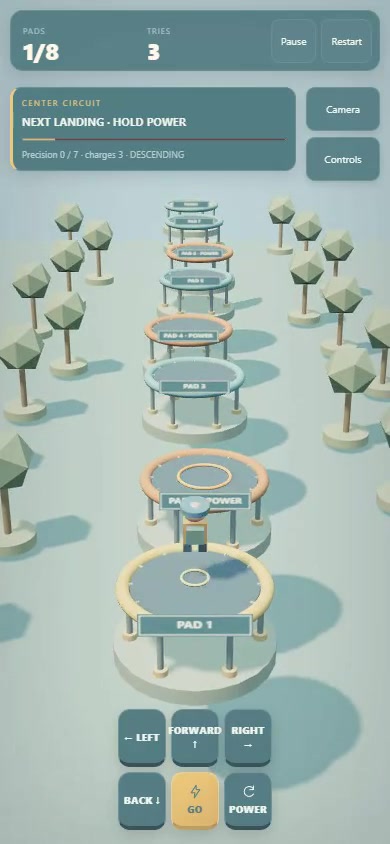
Orange-rimmed trampolines precede long gaps and call for powered rebounds. Cyan rims indicate the shorter jumps where you can save power. The run starts with three charges, matching the need to plan their use carefully. Holding POWER on every landing spends a limited resource even when an ordinary rebound would have been sufficient for the following section.
A centre ring marks the next landing target, and an amber indication reminds you to hold POWER for its upcoming long gap. The status panel also distinguishes rising and descending movement. Combine those cues: identify the target, align during flight, then have the correct power input ready for contact. The follow and overhead camera options offer different views of the same route, rather than changing its rules.
Precision is a separate achievement
Landing on the wrong numbered pad or missing a trampoline uses one of three attempts. A retry resets the route rather than continuing from the last successful landing. Stars depend on which attempt succeeds: three on the first, two on the second and one on the third. That makes consistent early jumps valuable when you are trying to learn a later part of the circuit.
A landing within 0.55 metres of a pad's centre counts as a precision hit. The Center Circuit seal requires five such hits on the first attempt. You do not need every landing to be perfect to earn it, but merely touching an edge throughout the course is not enough. First learn to finish, then use the centre ring to make the same sequence more controlled.
Why the rebound creates a rhythm
My reading of the design is that Bounce Circuit links short-term control with forward planning. Steering asks where the rider will land now; the power decision asks what must happen immediately afterward. Those tasks overlap during descent. A clean sequence can therefore feel like a rhythm you understand, rather than a collection of unrelated jumps or a test of how quickly you can press a button.
The numbered route gives mistakes a clear context, while the precision counter offers a goal beyond basic survival. The three-attempt structure also creates a reason to value repeatability. These are interpretations of the playable systems, not invented claims about developer intent. A useful practice routine is to name the next pad and its power requirement before concentrating on the final alignment of the landing.
Where to play
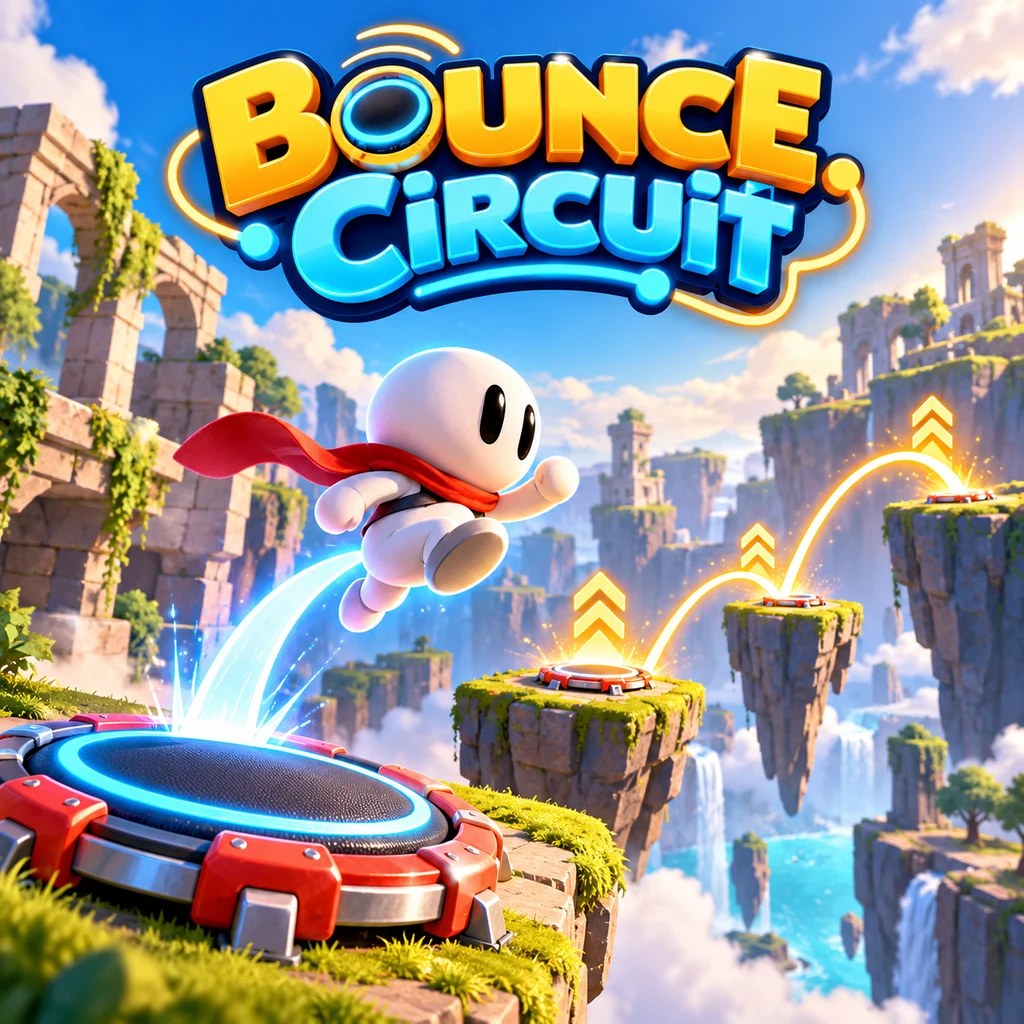
Play Bounce Circuit on Oppoz using the verified link below. The current game and official preview are linked as primary sources. The gallery uses actual airborne frames from that preview, while the cover is promotional artwork rather than an in-game scene. Exact matching releases on CrazyGames, Playgama and Google Play have not been verified, so those platforms are not listed as available destinations.
Inside the game