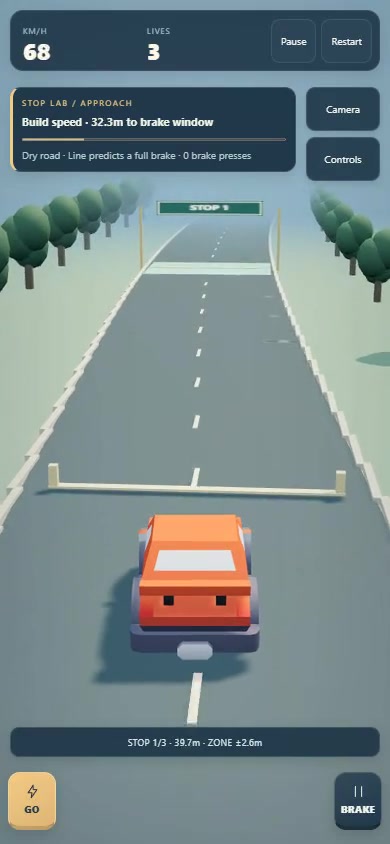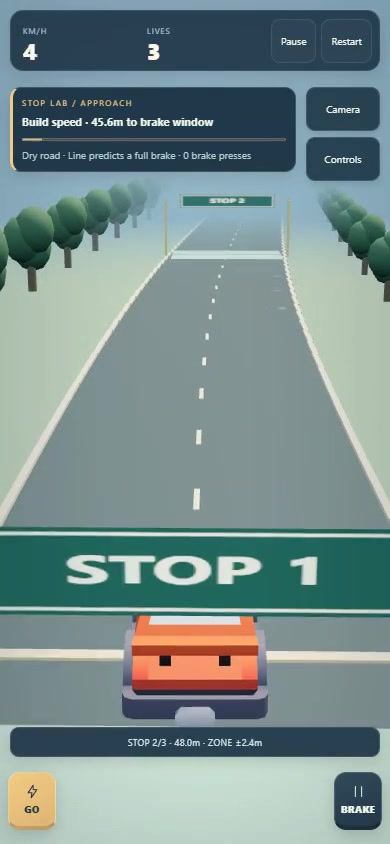

Brake Point: learn where to brake, not just when the road ends
Three precise stops form each driving challenge, with changing grip, a stopping marker and optional unassisted Gold Licences.
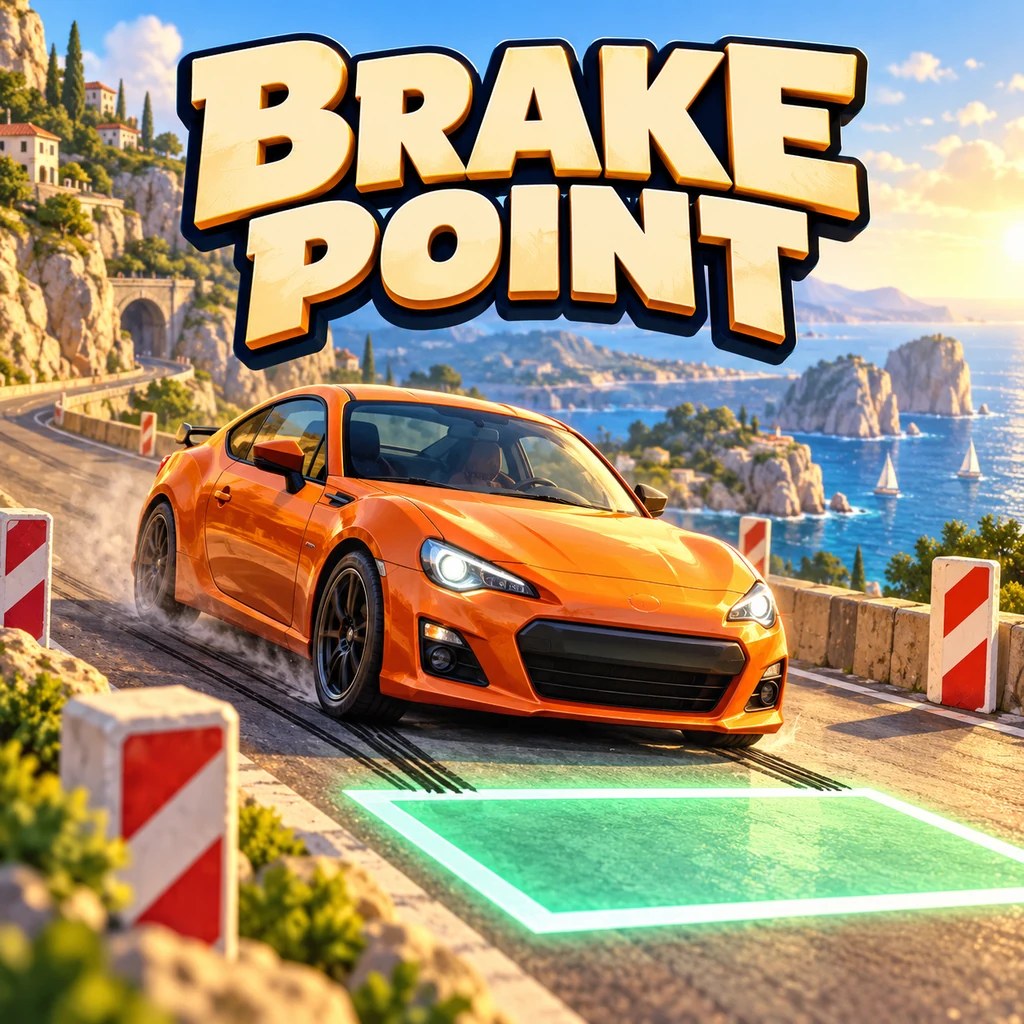
A driving game about the last few metres
Brake Point reduces a driving challenge to a very specific skill: stopping a car inside a marked zone. You do not steer through corners or compete with other cars. Instead, you watch speed, distance and road grip, then decide when to hold the brake. A good approach ends with the vehicle fully settled in the mint area, ideally close to its centre.
There are twenty-four challenges, each containing three stops. The zones become tighter within a challenge, and later challenges add changes in speed and grip. That means a timing habit learned on one approach is a starting point rather than a universal answer. The task remains easy to describe while the margin for a precise result gradually becomes more demanding.
Start the run, then commit to a brake
GO or Space begins an approach. Hold BRAKE or S to slow down; releasing the brake makes the car accelerate again. The down arrow also brakes on a keyboard. A successful stop requires the car to remain almost stationary within the zone for a short moment. Passing through slowly is not enough, and stopping beyond its far edge counts as an overshoot.
Each challenge provides three lives. Overshooting the zone or spending more than thirty seconds on an approach costs a life and resets that attempt. These limits encourage you to learn a useful braking point rather than inch toward every line indefinitely. Keep your attention on the approaching zone and speed together: the same remaining distance can demand different decisions when the car is travelling faster.
The marker predicts a full brake
With Coach enabled, a road marker estimates where the car would stop if you held BRAKE now. Its colour and the accompanying prompt show whether that prediction is short of the zone, inside it or beyond it. The marker is about the consequence of braking, not simply the car's current position. It moves as speed and remaining distance change.
Use the guide to connect what you see with what the car does. Notice the point at which a full brake begins to look useful, then hold the input and watch the approach finish. On a lower-grip surface, stopping takes more distance. Waiting for the same roadside position that worked on dry road can therefore produce an overshoot. The surface information is part of the decision, not merely scenery.
Precision rewards the centre of the zone
Stopping anywhere inside the permitted area can complete an approach, but precision improves as you finish closer to the centre. The game reports that result before moving to the next stop. Treat it as feedback on your timing. If you stopped short of the centre, consider a slightly later brake next time; if you stopped long, consider an earlier one under comparable conditions.
Repeatedly releasing and pressing the brake can rescue some approaches, but a clean single application matters for the strongest results. The game tracks brake presses as well as precision and lives. On an early attempt, focus on securing three stops. On a replay, aim for a consistent single-brake approach rather than changing several parts of your technique after every small error.
Gold Licences remove the training guide
Coach can be switched off in the menu. An optional Gold Licence requires three stops of at least eighty-five percent precision, one brake application per stop and no lives lost, with Coach off. That is a different objective from simply completing the challenge. You are replacing the visible stopping prediction with your own judgment while still meeting a specific accuracy target.
A useful progression is to practice with the guide, watch how grip changes the required distance, then attempt the unassisted version. Keep the road conditions in mind rather than copying a delay counted from GO. The camera option can also help you choose a view in which the zone is easy to judge. Choose a consistent view while learning so that a changed perspective does not become another unnecessary variable.
The satisfaction is in a controlled finish
Our interpretation of the design is that a tiny difference in timing produces unusually clear feedback. The car either settles where you intended or reveals how far the prediction was off. Three stops make consistency visible, while the optional licence gives an experienced player a concrete reason to return. This is analysis of the implemented game, not an invented account of developer intentions or evidence of real-world driving training.
The verified Oppoz release is linked in Where to play. Images pair official promotional cover art with genuine gameplay-preview frames. Targeted searches of CrazyGames, Playgama and Google Play did not establish matching external listings for this exact portfolio game. External availability remains unresolved; the article includes only the confirmed release link.
Inside the game