
Domino Workshop: Build a Chain That Reaches All Three Bells
Draw around obstacles, test the falling wave and refine your layout without losing the work you have already placed.
A workbench for small experiments
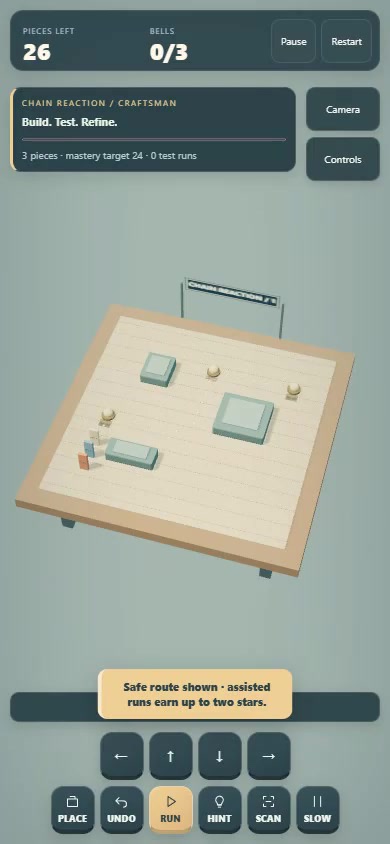
Domino Workshop gives you a wooden bench, three bells and a limited supply of dominoes. The objective is to build a connected chain around the obstacles, tip the first piece and make the falling wave reach every bell. It is a construction puzzle with a visible payoff: your plan becomes a moving sequence, and you can watch exactly where it succeeds or stops.
There are 24 workshop challenges. Each provides a starting domino, obstacle arrangement, piece budget and target for efficient construction. You extend the chain from its last piece rather than placing disconnected decorations anywhere on the table. This makes the route matter from the beginning: a detour around one block can leave you with fewer pieces for the final bell.
Draw the route, then inspect the corners
Drag or tap on the bench to extend the chain. Pieces are spaced automatically along the path you draw. For keyboard control, move the cursor with the arrows and use PLACE or Space to extend toward it. UNDO or Z reclaims the last placed piece, allowing you to work backward when a section needs reshaping.
The next domino must be close enough and in the direction the previous one falls. A chain can therefore fail even when its pieces appear to form a continuous line from above. Pay particular attention to corners and narrow passages beside workshop blocks. Leave enough room for the direction change, and avoid assuming that a falling piece can transmit the wave through an obstacle.
Run, watch and keep the useful parts
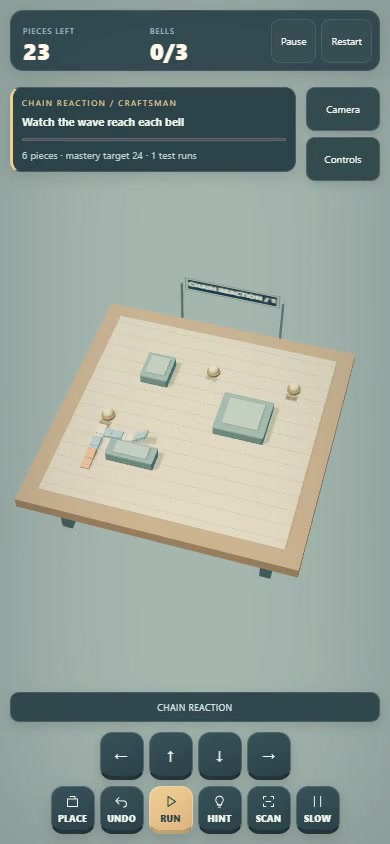
RUN or R tips the starting domino and tests the layout. If the reaction stops before all three bells ring, your placed pieces remain editable. You can adjust the end of the chain and run it again instead of rebuilding everything. The feedback is specific: you see which pieces fall, which bells respond and where the movement no longer reaches.
SLOW changes playback to 40 percent speed without reducing the available awards. It is useful when the wave crosses a corner too quickly to understand at normal speed. It does not repair a gap or change which dominoes can reach one another; it gives you more time to observe the same reaction. Use it to identify the first break rather than guessing at a distant section that never received the wave.
Assistance and the first-run challenge
SCAN forecasts which pieces receive the wave, using green for those reached and red for those that stop. HINT shows a safe route. Both are learning aids and cap the result at two stars when used. Ordinary undo and slow playback do not carry that same assistance penalty. The distinction lets you inspect and edit your own construction while reserving the explicit solution guidance for when you need it.
Three stars require an unassisted success on the first test run using no more than two pieces above the displayed target. The Master Craftsman seal is stricter: ring every bell on that first run without assistance and stay at or below the piece target itself. Solving the workshop and mastering it are therefore separate goals. Learn the propagation rules first, then return with a plan that needs fewer experiments.
Why a stopped chain can still be useful
Our design interpretation is that preserving the layout after a failed test makes experimentation feel productive. A stopped wave gives you information about a particular connection, while most of the construction stays intact. That supports a practical cycle of predicting, observing and revising. This is our analysis of the implemented mechanics, rather than a claim about undocumented developer intent.
The limited supply also creates a useful tension between generous spacing and economical routing. You want reliable connections, but you cannot solve every awkward section by adding unlimited pieces. A successful chain feels earned because the same layout satisfies several constraints at once: it avoids the blocks, carries the wave in the right direction and reaches all three bells within the available stock.
Before placing, trace a route through the bell positions and note the tightest turn. Build that section carefully, then inspect the path from the first domino outward. During a test, follow the front of the wave instead of looking only at the final bell. When it stops, the first unreachable piece usually tells you more than the empty space near the destination.
Where to play
Domino Workshop is verified live on Oppoz through the named link below. Matching CrazyGames, Playgama and Google Play releases were not verified for this exact portfolio title. The gallery contains actual gameplay frames from the official Oppoz preview. Its illustrated catalogue cover is labelled promotional artwork, not a screenshot.
Inside the game