
Elastic Launch: Use Each Shot to Find the Next Catch
Aim a sling at three elevated catchers, read the orange flight trail and adjust for distance, height and wind.

A small shooting course with a clear destination
Elastic Launch asks you to land a ball inside three elevated catchers using no more than six shots. The targets stand at different positions and heights, and later courses introduce wind. A hit requires the ball to enter the active catcher from above. Simply sending a shot toward its front or passing close to the rim does not complete the catch.
Across 24 courses, you adjust power and horizontal aim while the launch pitch stays fixed. This gives each shot a manageable set of decisions. More power changes the flight's reach, while sideways aim and wind affect where it crosses the target's height. The challenge is to connect what you see in the flight with a useful adjustment before spending another of your limited shots.
Pull the sling or use precise buttons
On the scene, drag downward to stretch the sling, move sideways to aim and release to launch. Keyboard and button controls offer an alternative: arrows adjust horizontal aim, POWER minus and plus or the 1 and 2 keys change power, and FIRE or Space launches. Use small changes when you are already near the target rather than replacing a nearly correct setup with a completely different shot.
The active catcher is identified by the aiming marker. Work through the catchers in sequence, checking which one is current after each success. Camera switches between chase and overview views. The chase view follows the flight closely, while the overview helps compare the target positions. Switching your view can make a miss easier to understand without changing the underlying course.
The dotted arc is only the beginning
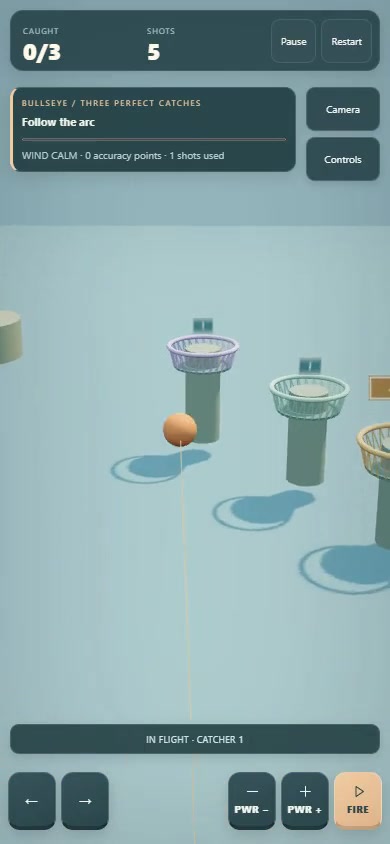
Before firing, a dotted arc previews the early part of the flight. It does not draw a complete guaranteed route into the catcher. Treat it as information about the launch, then watch the actual descent. A shot can look promising near the sling and still pass short, long or to one side when it reaches the elevated target.
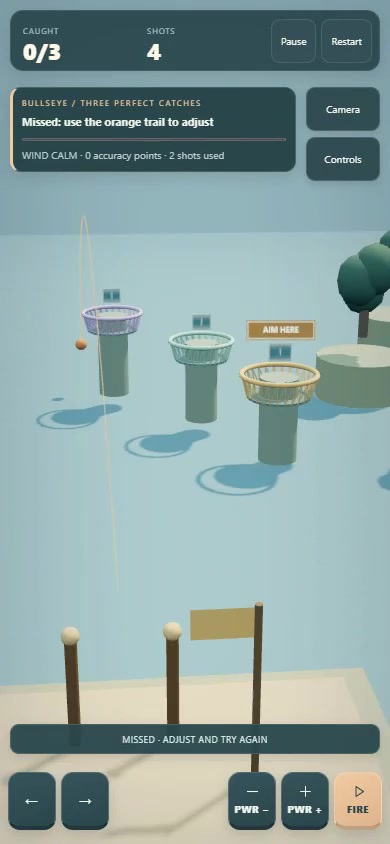
The orange trail records your actual shot and remains available to inspect afterward, until the next launch replaces it. Use that trail to compare the flight with the catcher rather than relying on a vague impression of the miss. If the sideways line looks wrong, adjust aim. If the shot reaches the target area at the wrong point in its descent, reconsider power and the catcher's height. Wind adds another reason to inspect the whole path.
Make the six-shot allowance count
Each course gives you six shots for three catches. A successful catch advances the target; a miss leaves you working on the same one with fewer shots available. The course ends unsuccessfully if the supply runs out before all three are caught. This creates room to learn from a miss, but not enough room to fire repeatedly without interpreting the result.
Three catches in exactly three shots earn three stars. Completing with one or two shots remaining earns two stars, while using the final shot for the last catch earns one. The Bullseye seal adds a precision requirement: finish in three shots with at least 90 percent average accuracy. Accuracy reflects how close each landing is to the catcher's centre, so a valid edge catch can still fall short of that stricter target.
Why the trail makes improvement readable
Our design reading is that the orange trail turns a miss into evidence. Instead of only being told that a shot failed, you can compare its route with the target and form a specific prediction for the next launch. The limited shot supply then gives that prediction a consequence. This is an interpretation of the implemented game, not a claim about undocumented developer intent.
The early preview and the actual trail play different roles. One helps you prepare; the other helps you diagnose. Keeping the preview incomplete leaves room for judgement, while preserving the last flight reduces the need to remember every moment of motion. A clean catch feels satisfying because you can connect a power or aim change to a visible improvement in the landing.
Start by making one adjustment at a time. If you change both power and aim dramatically after a miss, it becomes harder to tell which change helped. Once you can catch reliably, move your attention from the rim to the centre. That turns the same course into a more precise challenge without needing a new control or a different objective.
Where to play
Elastic Launch is verified live on Oppoz through the named play link below. Matching releases on CrazyGames, Playgama and Google Play remain unverified for this exact portfolio title. The gallery shows genuine frames from the official Oppoz preview, including a shot in flight and the trail after a miss. The cover is promotional artwork.
Inside the game