
Forklift Fit: The Right Crate at the Right Height
Plan a three-crate stack, travel beneath the beam and adjust your forks at the right moment in this compact warehouse challenge.
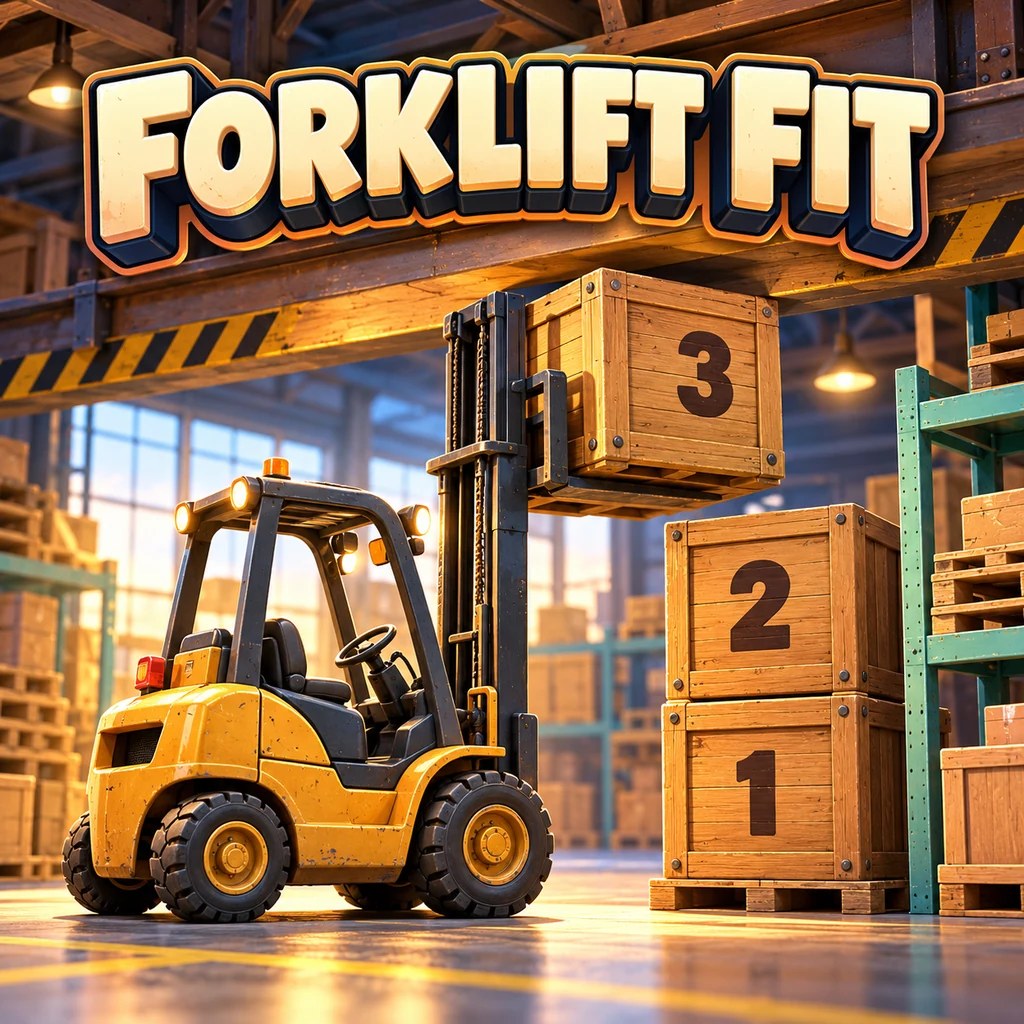
Three crates, several different heights
Forklift Fit is a warehouse puzzle about sequencing movement and lift height. Each job asks you to move three numbered crates from their stock positions into a required stack. The destination is easy to recognise, but reaching it with the correct crate means navigating stored cargo and a low overhead beam. A height that works for pickup is not automatically suitable for travel or placement.
The game offers 24 jobs and varies the required bottom-to-top crate order. Numbers make the order explicit, with colour adding another visual cue. Instead of asking you to master a large set of controls, it concentrates on a short repeated procedure: collect, raise to travel height, cross the warehouse, adjust for the stack and place. Keeping those steps in the correct order is the real challenge.
Controls and the basic delivery cycle
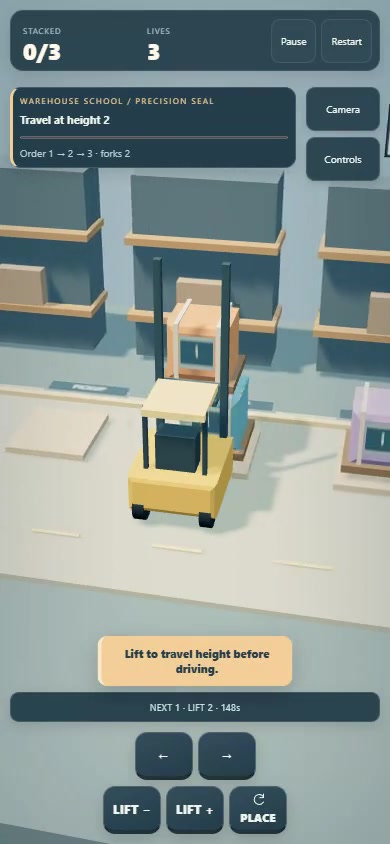
Hold the left and right controls to drive along the warehouse. Up and down change the fork height, and Space operates LOAD or PLACE; the on-screen buttons provide the same actions. Begin with the forks at height 1 to pick up the required crate. Align with its stock position and wait for the fork movement to stop before loading.
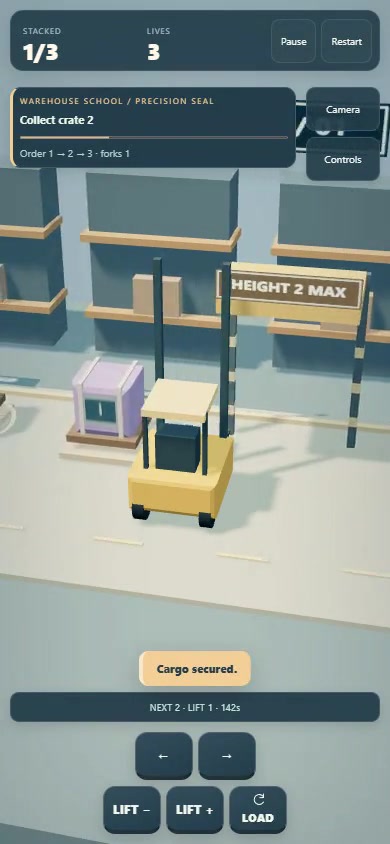
Once you have the crate, raise it to height 2 for travel. This clears the stored cargo while fitting beneath the low beam. After passing the beam, adjust the lift to the height needed for the next position in the stack. Align at the dock and place the crate. For the next collection, return to the pickup height rather than assuming the previous placement setting is still appropriate.
Read the order before moving
The interface shows the requested crate sequence and the next number to collect. Follow that sequence from the bottom of the stack upward. Simply transporting the nearest crate is not enough: the placement must match the next required number and the appropriate stack height. The three-crate order changes between jobs, so a routine memorised from one warehouse task can be wrong in the next.
A useful plan is to separate the job into three questions. Which crate is next? What height is safe during the journey? What height will its final stack position require? Answering those questions before driving avoids a common mistake: raising for the destination too early and hitting the beam on the way there. The optional camera view can help make the spatial relationship easier to inspect.
Damage, time and a cleaner second attempt
Impacts cost lives, and three impacts end the attempt. A carried crate returns to stock after a collision, while crates already placed in the completed part of the stack remain there. This preserves some progress, but the recovery still costs time and forces another collection trip. It is usually more productive to pause for a height adjustment than to rush into a clearance problem.
The shift has a time limit that becomes slightly shorter across the jobs. A three-star result requires finishing without damage; the additional precision seal asks for that clean completion in under 90 seconds. These goals encourage a smooth sequence rather than constant acceleration. Learn the clearance changes first, then improve by reducing unnecessary stops and choosing the next crate promptly.
Why the repeated process stays interesting
Our interpretation is that Forklift Fit draws its appeal from remembering a small rule while the surrounding context changes. Height 2 is useful for travel, but the correct pickup and placement heights differ. The player must switch between those purposes at the right locations. This is analysis of the game's visible systems, not a claim about an undocumented development brief.
The growing stack also gives your work a clear visual result. Each correct delivery resolves one part of the sequence and changes the height needed for the next. That makes progress easy to follow, while the beam prevents you from solving the task by leaving the forks raised permanently. Numbered crates, lift indicators and the next-crate prompt give you specific information to act on.
For an early run, focus on a clean cycle rather than the precision timer: pick up low, travel at the middle setting, then raise after the beam if the stack needs it. When that sequence feels reliable, look for moments where you are waiting without making a decision. Faster completion comes from knowing the next step, while careless height changes can erase the time you thought you saved.
Where to play
Use the verified Oppoz link below to play Forklift Fit in the browser. A matching release on CrazyGames, Playgama or Google Play has not been verified for this exact portfolio title. The gallery uses genuine frames from its official Oppoz gameplay preview. The stylized catalogue cover is promotional artwork and is labelled separately from those gameplay images.
Inside the game