
Gear Bridge: Connect the Motor Without Losing the Direction
Fit a small gear network, match two output rotations and open both bridge spans for a waiting courier.
A crossing powered by your layout
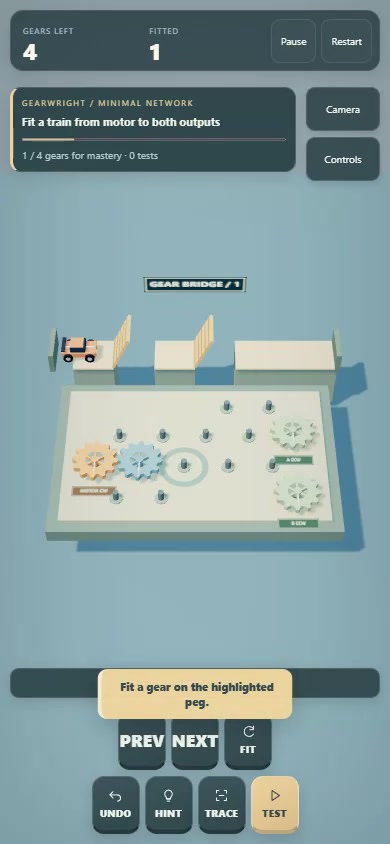
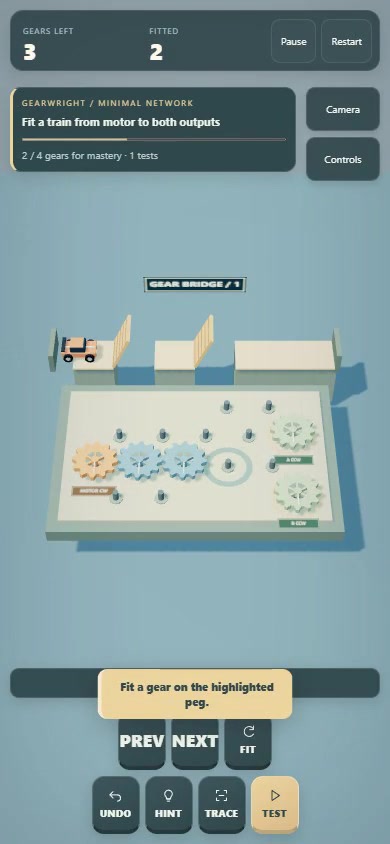
Gear Bridge turns a bridge repair into a mechanical logic puzzle. A clockwise motor sits on a board of pegs, with two fixed output gears controlling separate bridge spans. You fit the missing gears, run the motor and try to make both outputs turn in their required directions. When the network works, the spans open into a usable crossing and a small courier vehicle drives across.
The game contains 24 challenges, each with a limited stock of spare gears and a minimum-gear target. Filling every available peg is not the objective. Extra gears can consume your supply or create an inconsistent loop. You need a network that carries power from the motor to both outputs while preserving the correct sequence of direction reversals.
Fit gears and read the output labels
Tap an available peg to add or remove a gear. Alternatively, use NEXT and PREV to select a peg and FIT or Space to toggle it. The motor and output gears are fixed, so your decisions concern the intermediate connections. UNDO or Z restores a previous change, making it easy to compare a revised route with the layout you had before.
Every pair of adjacent meshing gears turns in opposite directions. Starting from the clockwise motor, the first connected neighbour turns counter-clockwise, the next clockwise, and so on. Read the CW or CCW requirement beside each output before you build. A connected output can still be wrong: receiving power and rotating in the required direction are separate conditions.
Why a loop can stop the whole mechanism
A loop containing an odd number of connected gears demands incompatible directions. Following the reversals around it brings you back to a gear that would need to turn both ways. Gear Bridge recognises that conflict as a jam. This is why a new connection can make a previously useful route worse instead of simply adding another path for power.
Before testing, trace each branch from the motor and alternate the direction at every connection. If two branches meet, check that they agree about the shared gear's rotation. When the layout jams, try removing a connection that closes the conflicting loop rather than adding more gears. The useful question is which connections are necessary for the two outputs, not how much of the board you can fill.
Test, diagnose and refine
TEST or R runs the mechanism. A failed test keeps your layout editable, so you can make a specific correction and try again. Watch whether an output lacks power, turns the wrong way or belongs to a jammed network. These are different problems: a missing connection needs a route, while a direction mismatch may require changing the route's number of reversals.
TRACE reveals the powered network with colours for clockwise, counter-clockwise, disconnected and jammed states. HINT suggests a gear to fit or remove. Both tools cap the result at two stars when used. They are useful for learning how the network behaves, but the strongest solution must be found without them. Ordinary undo lets you revise placements without that same assistance flag.
An unassisted minimum-gear solution that succeeds on the first test earns three stars and the Gearwright seal. This makes mastery more demanding than opening the bridges eventually. First learn to recognise a working train; then replay with enough confidence to remove unnecessary gears and test only when both outputs should agree with their labels.
Why the bridge payoff matters
Our design interpretation is that the courier crossing gives an abstract rotation puzzle a concrete result. The gears are not spinning only to satisfy a diagram: their two outputs operate something visible beyond the board. That final movement makes the connection between the small mechanism and the larger task easy to understand. This is analysis of the implemented experience, not documented developer intent.
The puzzle also separates building from testing. During construction, you can reason through the network without a countdown forcing a guess. During the test, the moving gears show whether your prediction was right. A successful first test feels different from a lucky edit because you can explain how each reversal contributes to the crossing.
For a practical starting routine, read both output labels, follow the shortest plausible motor connection and count reversals along each branch. Check shared connections last. If you need TRACE while learning, use its colours to explain the result to yourself, then try an unassisted replay with the same reasoning.
Where to play
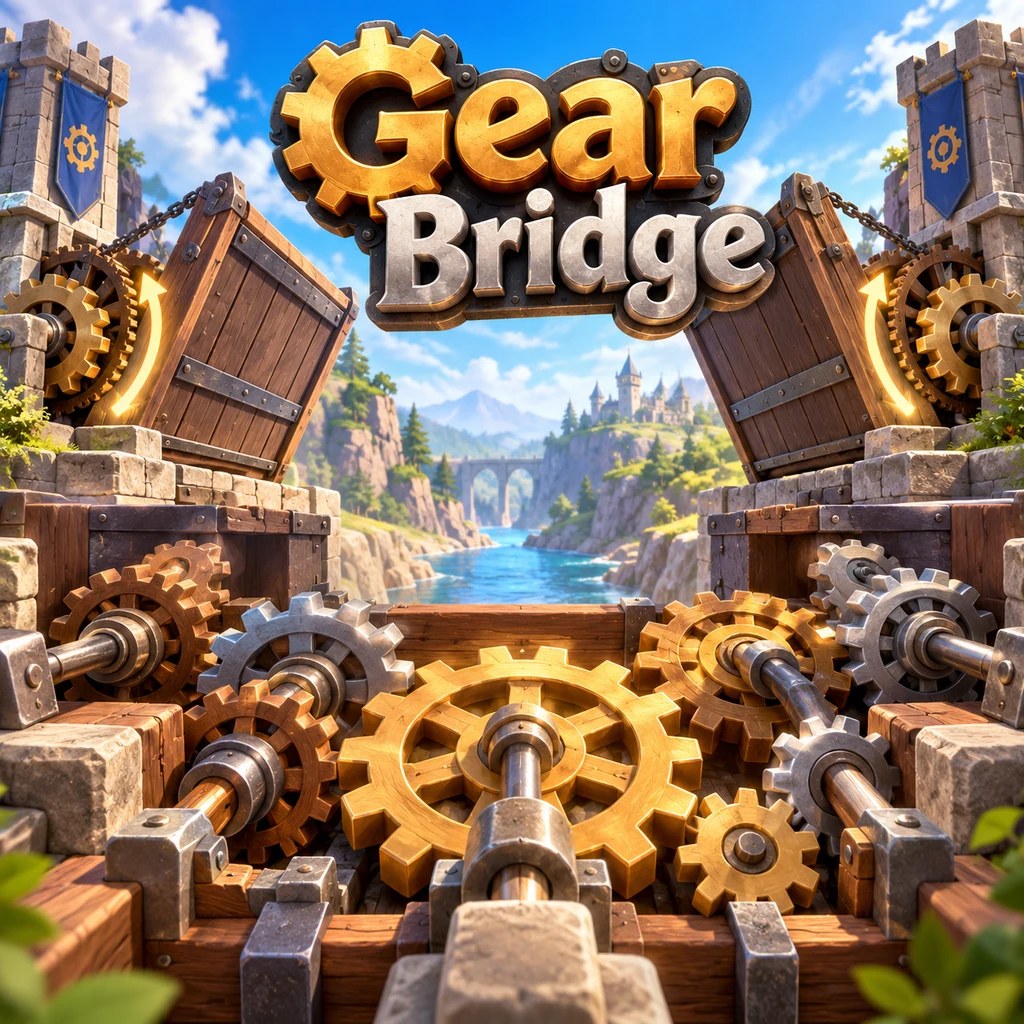
Gear Bridge is verified live on Oppoz through the named link below. Matching releases on CrazyGames, Playgama and Google Play remain unverified for this exact portfolio title. The gallery shows genuine frames from its official Oppoz preview; the illustrated cover is promotional artwork rather than a gameplay capture.
Inside the game