
Gravity Rooms: Find a Route Through All Three Dimensions
Send a recovery pod between barriers, gather two cores and reach the exit by choosing where each gravity shift will end.
A room you solve from several angles
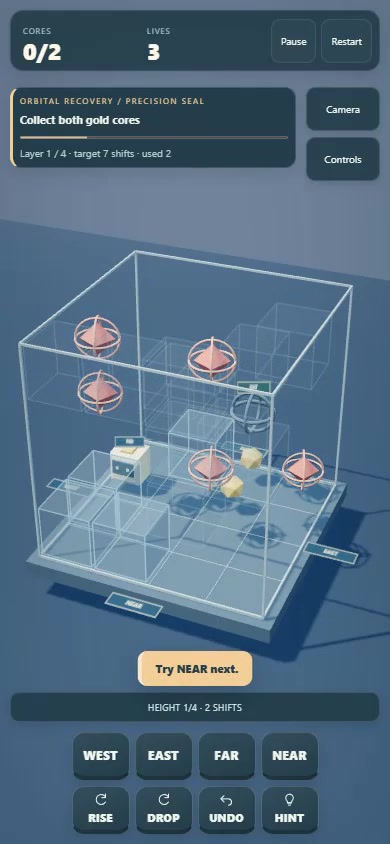
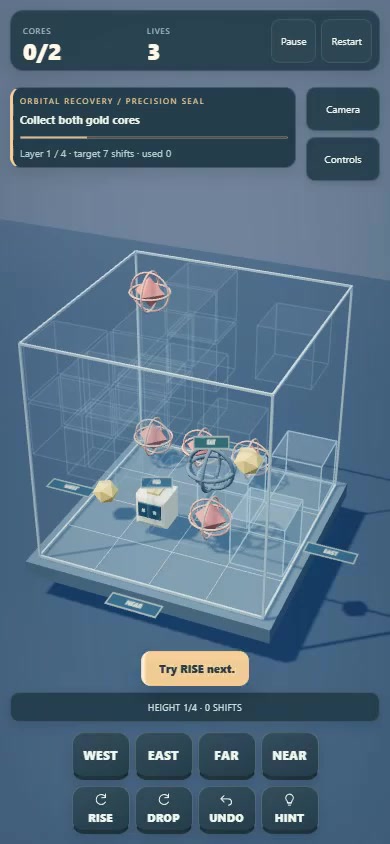
Gravity Rooms places a recovery pod inside a transparent chamber containing barriers, red hazards, two gold power cores and an exit. Instead of walking along a floor, you choose one of six directions and send the pod travelling until it is blocked. The room has four layers of height, so a useful route can go above or below an obstacle that appears to block the way from the first camera angle.
The game contains 24 chambers. Each is a compact spatial puzzle rather than a free-flight course: a command commits the pod to a straight movement, and you make the next choice after it stops. Reaching the exit requires both cores first. You must therefore work out a sequence of stopping points that connects the collectibles to the final destination without carrying the pod through a hazard.
Six commands and a fixed room compass
WEST and EAST move across one horizontal axis; FAR and NEAR cover the other. RISE and DROP move vertically. On a keyboard, use the arrow keys for the horizontal directions, Q to rise and E to drop. The on-screen buttons carry the same names, making the distinction between depth and height explicit.
Camera rotates your view around the chamber, but the direction names remain fixed to the room. After changing the view, do not assume that screen-left is still WEST. Read the room labels and inspect the pod's current layer before issuing a command. The height display helps locate it vertically, while barriers on the current layer are drawn more prominently to make that slice of the chamber easier to interpret.
Think about the destination of every shift
The pod continues until a barrier or the chamber boundary blocks further movement. A core is collected when the pod passes through its position, but collecting one does not normally stop the shift. That means a promising line toward gold can still be unsafe if a red hazard lies farther along the same path. Trace the whole movement, including the square where the pod will finally rest.
Transparent barriers let you inspect objects behind them, but transparency does not mean the pod can pass through. Rotate the camera to distinguish an obstacle on the current route from one on another layer. Before a vertical move, inspect the column above or below you. Before a horizontal move, check both the relevant row and the current height. The chamber rewards this deliberate separation of axes.
Recovery, assistance and efficient solutions
A hazard impact removes a life and resets the pod and collected-core state for that chamber. Three impacts end the run. Commands that are immediately blocked do not consume a shift. There is no need to keep issuing inputs while the pod is travelling; use the completed move to reassess where you are and which directions are now open.
UNDO or Z restores a previous recorded state. HINT or H suggests a next direction from your current state, or reports that you should undo or restart if no route is available. Using either assist caps the result at two stars. These tools make a confusing chamber easier to study, but an unassisted replay is needed for the strongest completion.
Three stars require all three lives and completion within two shifts of the target. The precision seal tightens that requirement to the target itself, without assistance or impacts. First find a safe recovery route, then compare the stopping points in your solution with the target count. A route that looks longer in physical distance can use fewer commands if each shift places the pod somewhere productive.
Why changing perspective changes the puzzle
Our design interpretation is that Gravity Rooms asks you to build a mental model rather than trust one picture. The camera reveals the same fixed chamber from different sides, while the controls stay tied to its axes. Understanding that relationship can turn an apparently blocked route into a clear sequence through another layer. This is analysis of the implemented experience, not a claim about undocumented developer intentions.
The two cores give you intermediate goals, but each collection also changes what a successful finish means. Once both are secured, the problem becomes arranging a final line into the exit. The short command set keeps the interaction accessible while the three-dimensional layout supplies the complexity. Satisfaction comes from predicting a shift correctly and seeing the pod arrive exactly where your plan needs it.
A useful first routine is to locate both cores, locate the exit, then examine the barriers beside each. Ask which surfaces could stop the pod in line with those targets. Rotate the view whenever two objects appear to overlap. That extra inspection can save an entire reset and gradually makes the chamber feel readable instead of visually crowded.
Where to play
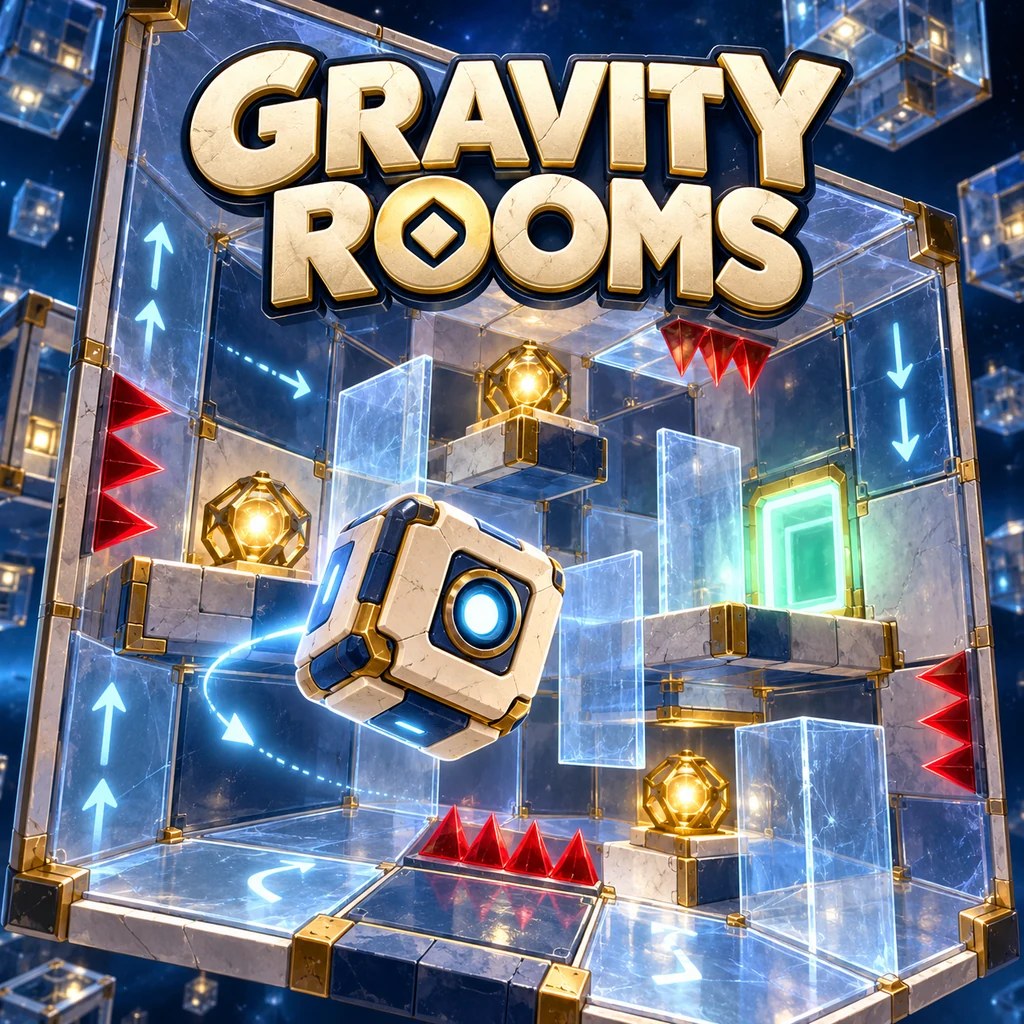
Gravity Rooms is verified live on Oppoz through the named link below. Matching CrazyGames, Playgama and Google Play releases have not been verified for this exact title. The gallery uses genuine frames from the official Oppoz preview, and the stylized cover is separately identified as promotional art.
Inside the game