
Laser Prism: Follow the Beam Through Three Dimensions
Rotate six-plane mirrors, charge three crystals and use a live beam preview to diagnose an optical puzzle before firing.
An optical route with a third dimension
Laser Prism asks you to connect a source to a receiver inside a three-dimensional chamber. Between them are adjustable mirrors, three crystals and obstacles that can absorb the beam. Reaching the receiver alone is not a solution: all three crystals must be charged along the route. The challenge is to understand how each mirror changes the beam's direction through the space.
The current game offers 24 chambers. Rather than dragging mirrors freely, you select from six possible mirror planes at fixed positions. That turns a potentially vague aiming exercise into a sequence of concrete choices. Each orientation produces a visible consequence, and the route can move vertically as well as across the chamber floor. A reflection that looks plausible from one viewpoint may need another look from the side.
Select, turn and inspect
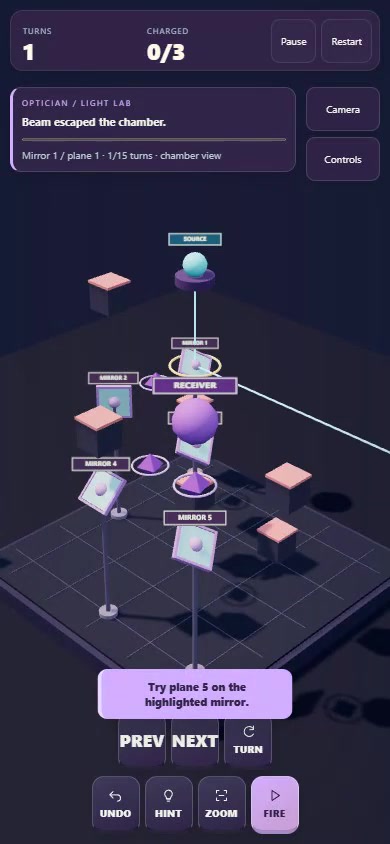
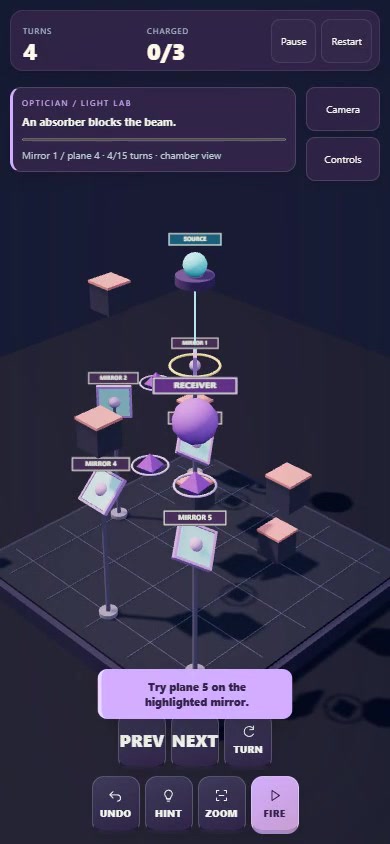
Tap a mirror to select it, then use TURN or Space to cycle its plane. PREV and NEXT move the selection between mirrors. The interface identifies both the selected mirror and its current plane, so you can connect an adjustment to the object you are studying. Tapping a mirror selects it; the separate turn command changes its orientation.
Use Camera or V to rotate the chamber view. ZOOM or I brings the selected mirror closer, and WIDE returns to the full chamber. These views are especially useful when two objects overlap visually. Before turning another mirror, inspect where the incoming beam reaches the selected one and where the new outgoing segment travels. Work from the source instead of assuming every visible mirror needs immediate adjustment.
The preview is your diagnostic tool
A blue preview beam updates with the layout, showing the current route before you commit to a test. Crystals change appearance when the preview reaches them, while a coral marker identifies where an unsuccessful beam stops. The status text also explains problems such as escaping the chamber, encountering an absorber or becoming trapped in a loop.
This feedback lets you repair the earliest break in the route and then inspect what happens farther along. The receiver only counts as connected when every crystal has been visited. If the beam reaches it too soon, look for the missing crystal rather than treating the final connection as proof the whole puzzle is solved. The preview makes this distinction visible before FIRE.
Test carefully, improve deliberately
FIRE or R runs the laser test. A failed test preserves the mirror layout, so you can continue from your existing arrangement. UNDO or Z restores the previous turn and its recorded count. HINT or H selects a correction from the reference route and identifies a useful plane; using that assistance caps the star award at two.
The Optician seal requires an unassisted solution on the first test within the reference turn target. That same efficient first-test performance earns three stars. The target gives you a reason to plan a mirror's orientation before cycling through it repeatedly. On an exploratory attempt, however, a failed test can still be informative. Understanding the route is a useful first goal before aiming for the seal.
Why the light path is satisfying
My design analysis is that Laser Prism makes spatial reasoning observable. Instead of keeping a complete imagined route in memory, you can compare it with the preview after each change. A useful adjustment extends a line you can follow, charges another crystal or reveals the next obstruction. Progress becomes a visible chain of causes rather than an unexplained increase in a completion meter.
The chamber camera adds a second kind of decision: sometimes the best next action is to look from another angle. That rewards inspection alongside manipulation. Meanwhile, the turn target and first-test seal give careful players something to pursue after basic completion. These are interpretations of the current systems, not claims about undocumented developer intentions. A strong opening habit is to explain the next reflection to yourself before pressing TURN.
Where to play
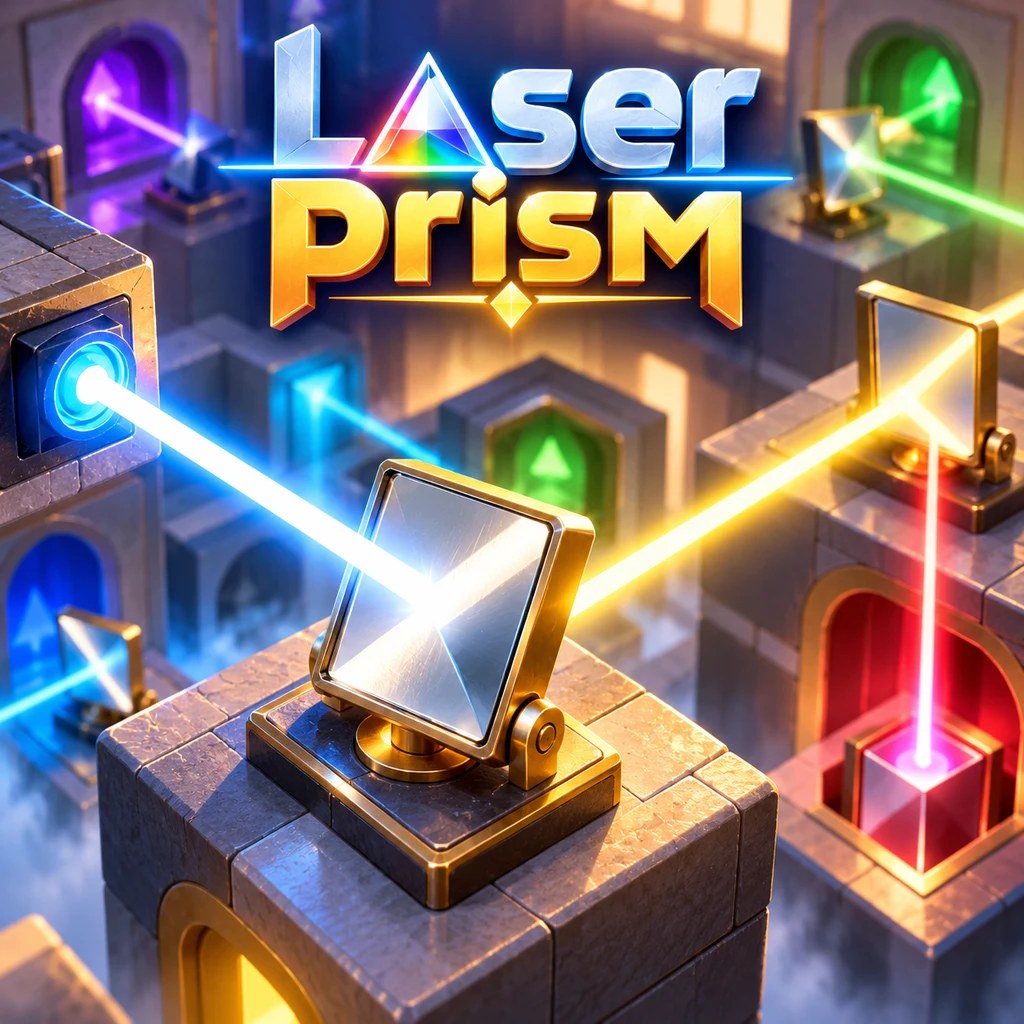
Play Laser Prism on Oppoz using the verified link below. The linked game and its official preview provide primary references for this spotlight. The gallery contains genuine preview frames, and the cover is promotional artwork rather than an in-game capture. Matching releases on CrazyGames, Playgama and Google Play remain unverified, so no additional store availability is claimed.
Inside the game