
Magnet Marble: Change Polarity, Change the Route
Pull and repel do more than reverse direction: they also change which gates are open in this sliding laboratory puzzle.
A laboratory where the walls help you
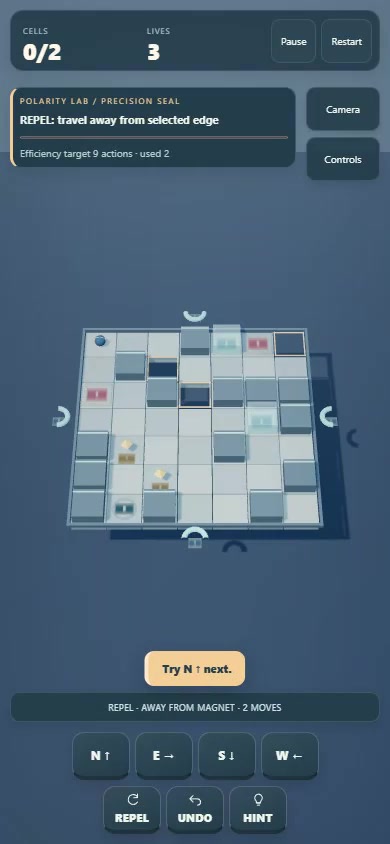
Magnet Marble asks you to collect two energy cells and send a marble into a receiver marked RX. Four magnets surround a seven-by-seven laboratory board, with walls, pits and colour-coded gates inside. A pulse moves the marble along a straight line until something blocks it. You cannot simply choose an arbitrary tile and stop there, so the obstacles become tools for positioning as well as barriers.
There are 24 laboratories to solve. Each combines the same small set of actions with a different routing problem. The interesting question is not just which direction reaches a cell, but where that movement will finish and what becomes possible from the stopping point. A seemingly indirect route can be useful if it places the marble beside the right wall for the next pulse.
Understand what the magnet buttons mean
Tap N, E, S or W, or use the corresponding arrow key, to pulse a magnet on that edge. In PULL mode, the marble moves toward the selected magnet. In REPEL mode, it travels away from that same edge. The controls identify the magnet you activate, not an unconditional direction of travel. For example, the north magnet sends the marble south when repel is active.
Use the mode button or Space to switch polarity. The current setting is displayed, and changing it counts as an action. A movement that cannot leave its starting square is rejected without adding a move. Before pressing a magnet button, check the mode, trace the resulting direction and locate the first obstacle or hazard along that line. This small pause prevents a mistaken reversal from becoming a pit fall.
Polarity also controls the gates
Blue gates marked A open in PULL mode, while coral gates marked R open in REPEL mode. Switching polarity therefore changes both the direction associated with a magnet and the board's available passages. A gate that stopped you on one move may allow the next slide to continue much farther. Its role can change from a useful stopping surface to a route through the laboratory.
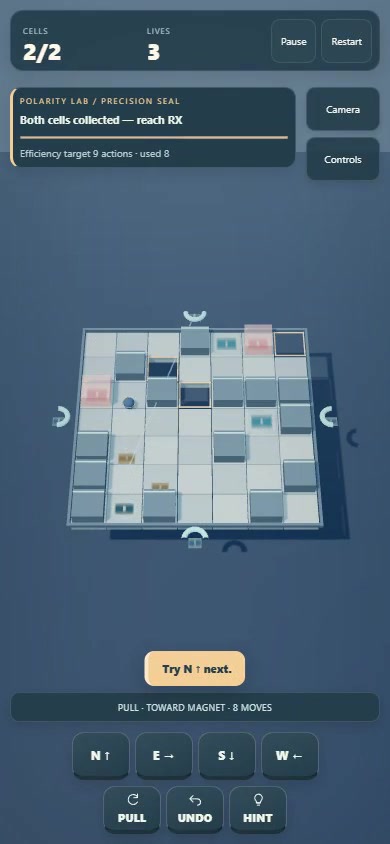
Both energy cells must be collected before the receiver can complete the puzzle. Passing a cell during a slide collects it, but the marble ordinarily keeps travelling afterward. Plan around where you will land, rather than assuming the collectible will stop your movement. Once both cells are gathered, arrange a line that reaches RX without crossing an open pit on the way.
Use the learning tools deliberately
UNDO or Z restores a previous recorded state, and HINT or H suggests a next action from the current position. Either assist marks the run as assisted and caps the completion at two stars. A hint can recommend a polarity change as well as a magnet pulse, which is useful when the obstacle is the board's mode rather than the marble's current location.
A pit fall costs a life and resets the laboratory state, including collected cells. Three falls end the run. For an unassisted three-star completion, keep all three lives and finish within two actions of the laboratory's target. The precision seal is stricter: complete without assistance or falls and meet the target action count itself. Mode changes belong in that count, so a shorter-looking path is not always the more efficient solution.
Why the same board can read differently
Our analysis is that the game's strongest idea is making one switch affect two relationships at once. Polarity changes how you interpret an edge button and which gates behave as walls. This encourages you to inspect the board as a changing system rather than memorise a single sequence of compass directions. That is a reading of the mechanics, not documented developer intent.
The satisfying discovery is often a new stopping point. A wall that seemed inconvenient can align the marble with a cell, while a closed gate can hold it somewhere useful until you switch modes. Learning that distinction turns the laboratory from a maze you push against into a set of surfaces you can use. The visible action target then gives a solved puzzle a second purpose: finding a cleaner explanation of the route.
For your first attempt, prioritise a safe path through both cells. On a replay, review every polarity change and ask what it accomplishes. Does it open a necessary gate, reverse the intended pulse, or both? Removing an unnecessary switch is a concrete improvement, and it helps you understand the puzzle rather than merely repeat it.
Where to play
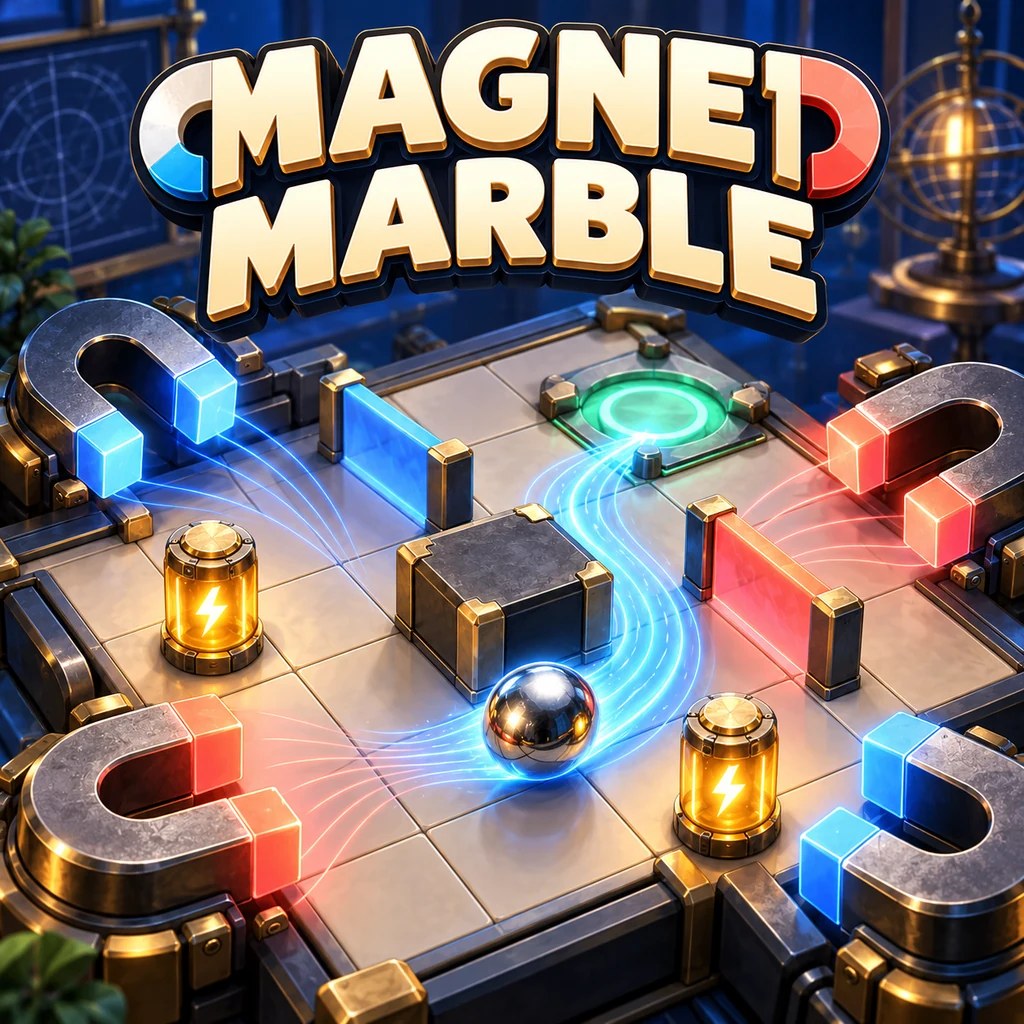
Play Magnet Marble on Oppoz using its verified link below. External releases on CrazyGames, Playgama and Google Play remain unverified for this exact game. The screenshots are labelled frames from its official Oppoz preview; the cover is official promotional artwork rather than a gameplay capture.
Inside the game