
Marble Switchyard: read the queue and make every junction count
Route symbol-marked marbles through three junctions, sharing a focus reserve between slowing traffic and holding new releases.
A small railway with four destinations
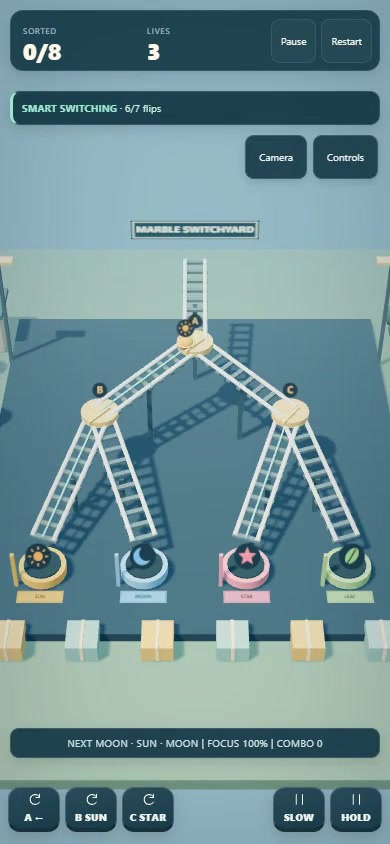
Marble Switchyard turns a branching set of rails into a compact routing challenge. Marbles enter at the top and roll toward four bins marked SUN, MOON, STAR and LEAF. Your job is to set the junctions so each delivery reaches its matching destination. The rails are easy to see, but several marbles can be travelling at once, which makes timing as important as recognizing the correct route.
There are twenty-four shifts in the current release. Early queues introduce a smaller set of destinations, while later ones use more of the yard and increase the traffic pressure. Each marble carries a symbol as well as a colour, matching the labels at the bins. That gives you more than one visual cue when deciding where a delivery belongs.
Understand A before worrying about B and C
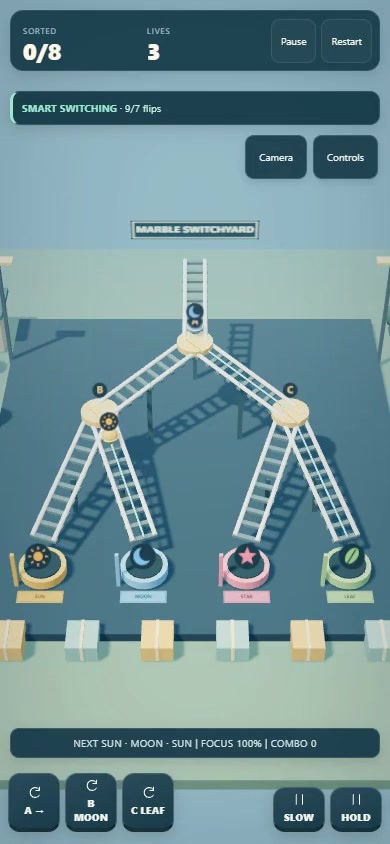
Tap a junction or use keys 1, 2 and 3 to flip switches A, B and C. A chooses the left or right branch. On the left, B routes to SUN or MOON; on the right, C routes to STAR or LEAF. Think of a destination as two decisions: choose its side of the yard, then choose the correct bin on that side.
The route is determined as a marble reaches each junction. Once it has passed A, changing A prepares the entrance for a later marble without changing the branch already taken by the first. B and C still matter when that first marble reaches them. Watch actual positions on the rails, rather than treating a single switch setting as a promise that lasts for the whole journey.
SLOW and HOLD solve different problems
Hold S or the SLOW button to spend focus and slow the moving marbles. Hold H or HOLD to pause new releases while marbles already on the rails continue travelling. Both actions draw from the same focus reserve. Focus recovers when neither is in use, so constant assistance is not a sustainable way to manage the yard.
Use SLOW when an approaching junction needs attention immediately. Use HOLD when the existing traffic is manageable but another arrival would make the next few decisions harder. Holding the hopper does not freeze a marble already approaching the wrong bin. That distinction is central to playing well: one tool buys slower movement, while the other gives you room to clear what is already moving.
Read ahead without forgetting the nearest marble
The NEXT display previews upcoming symbols, allowing you to prepare before a marble enters the yard. Start with the nearest unresolved junction, then look at the queue for the next decision. For example, a SUN and a MOON both need A to send them left, but they need different settings at B. Leave A alone and time the B change after the leading marble has passed it.
Correct deliveries build a combo, while a wrong bin breaks that chain and costs a life. Three mistakes end the shift. A completed shift with no misses earns three stars, with fewer stars when mistakes occur. On an initial attempt, focus on understanding the route and preserving lives. Chasing a large combo makes more sense once you can reliably distinguish an urgent switch from one that can wait.
Smart Switching rewards fewer unnecessary flips
The optional Smart Switching goal adds a visible flip budget. Finish without misses while staying within that budget to earn the seal and a bonus. Randomly cycling switches while waiting for a marble uses up that allowance, even if you eventually restore the correct route. A deliberate change is more valuable than keeping your hands busy.
For a cleaner replay, group your attention by branch. Consecutive SUN and MOON deliveries share A, while STAR and LEAF share the other branch. Change only what the next relevant marble requires, and avoid flipping a downstream junction before the current marble has safely crossed it. The goal is not to memorize frantic inputs; it is to notice which parts of a route can remain stable.
Why the yard creates a satisfying rhythm
Our interpretation of the design is that the visible travel time creates a useful gap between planning and consequence. You set a route, watch it work, then prepare the next one. Symbols and highlighted paths make those consequences readable. Sharing focus between two different tools creates a resource decision inside an otherwise simple control scheme. These are observations about the implemented mechanics, not claims about documented developer intentions or measured player psychology.
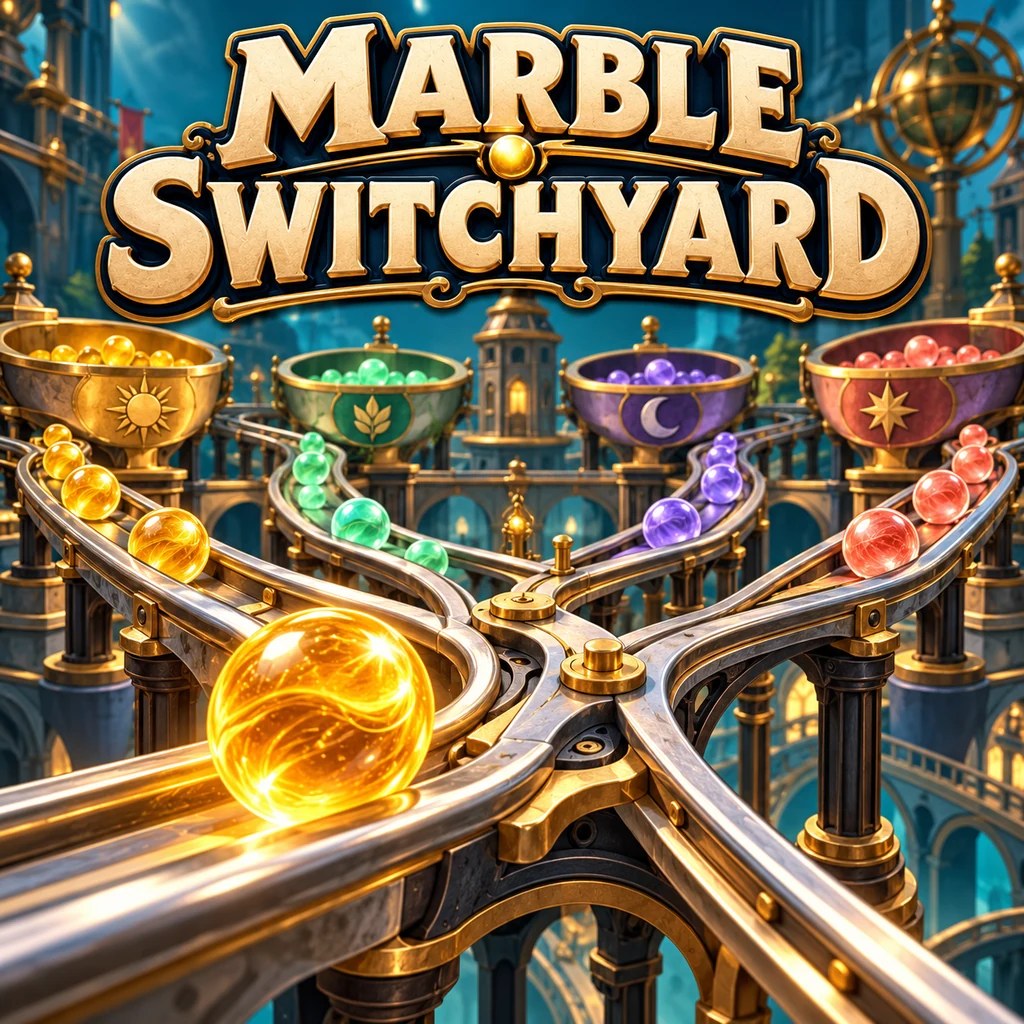
Play the verified Oppoz release through Where to play below. The gallery uses genuine frames from its official preview, while the cover is promotional artwork. Searches of CrazyGames, Playgama and Google Play did not verify a matching release for this exact game. External availability remains an open verification question, so this article links only the confirmed playable destination.
Inside the game