
Parking Sequence: clear the lane, then find a smoother way through the lot
Twenty-four untimed parking puzzles combine lane-bound movement, visible legal destinations and an optional car-switching challenge.
One reserved bay, several competing lanes
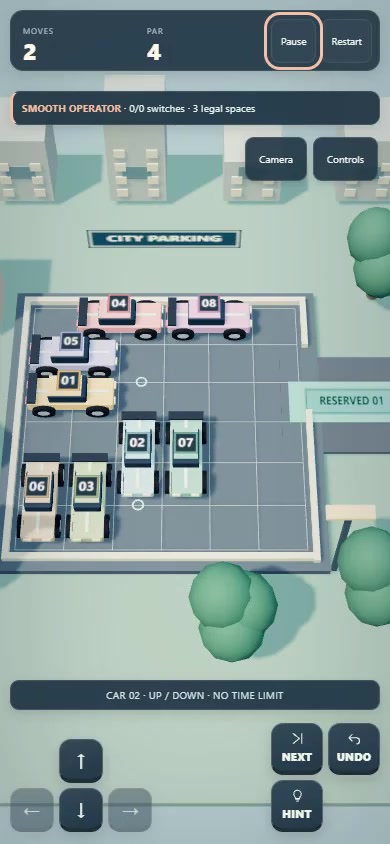
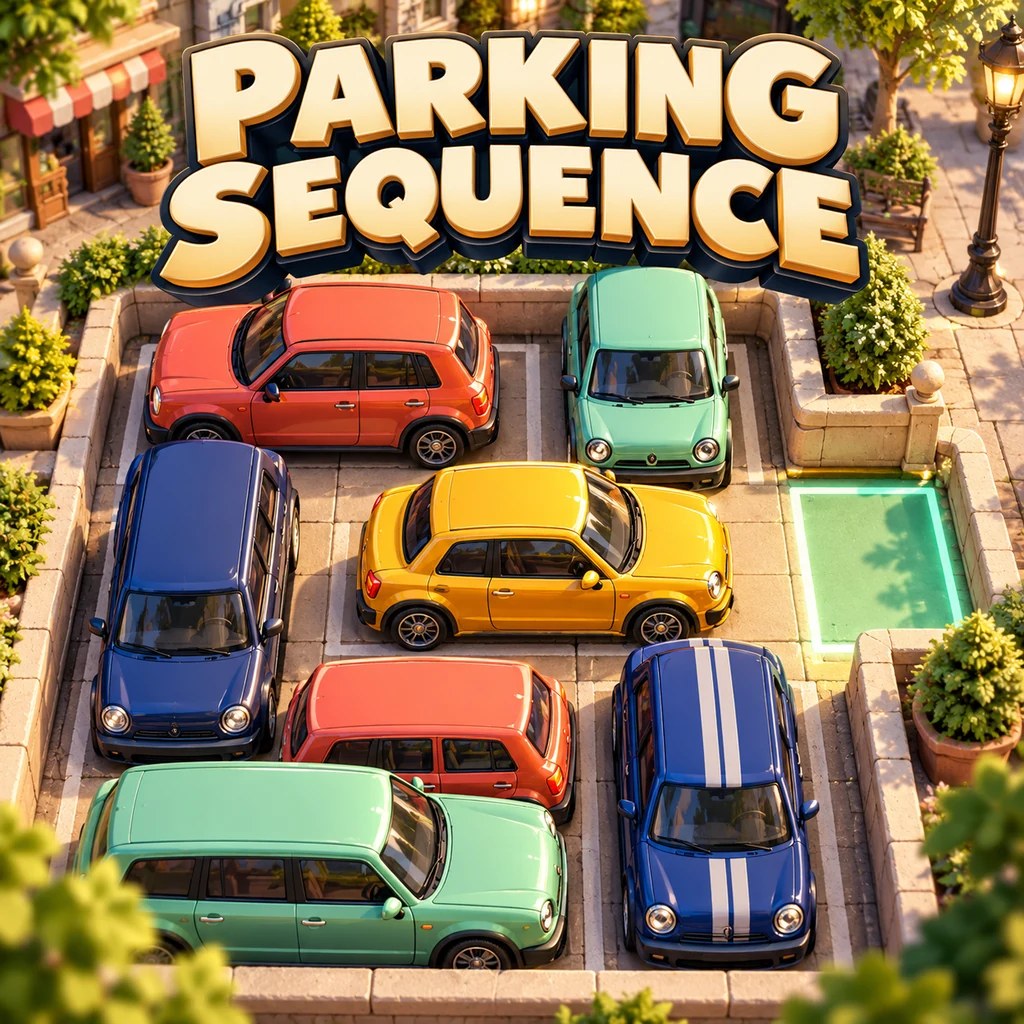
Parking Sequence begins with a clear destination: car 01 belongs in the reserved bay on the right side of a crowded lot. The difficulty lies in the other vehicles between it and that exit. Each vehicle moves along its own lane, so you cannot simply steer around an obstruction. You must rearrange the available space until the target car has a clear route.
The current release contains twenty-four puzzles. Its numbered cars make it possible to identify a vehicle even when several share similar shapes or colours. A move counter and par value give you a visible efficiency target, but there is no timer. That leaves room to inspect the lot, reconsider a sequence and work through a dependency without being hurried by a countdown.
How to read and move a car
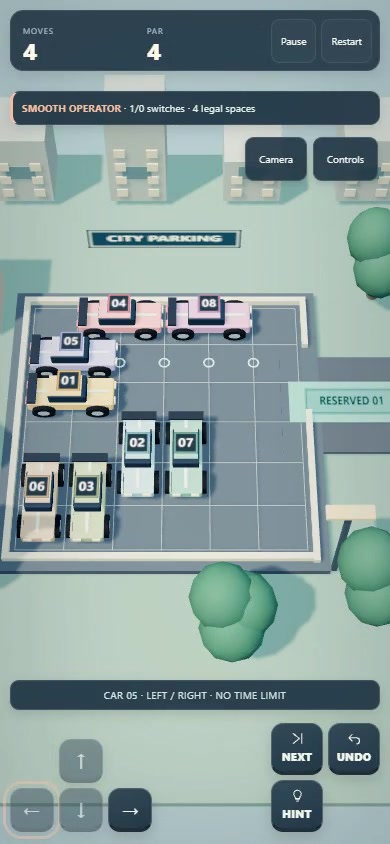
Drag a car along its lane, or tap it and use the directional controls. On a keyboard, the arrows move the selected car and Tab cycles through vehicles through the NEXT action. A horizontal vehicle moves left or right; a vertical one moves up or down. Selecting a car reveals dots for legal destinations, helping distinguish an available space from a route blocked by another vehicle.
Movement proceeds in grid spaces. A long drag can therefore represent several counted moves, rather than one cheap shortcut across the board. Look at the highlighted vehicle and the legal dots before moving, particularly when cars sit close together. A blocked input does not solve the obstruction: it is a cue to inspect the vehicle occupying the required space and trace what must move first.
The extra challenge is changing cars less often
Smooth Operator adds a second way to judge a solution. It tracks changes between the cars you actually move, rather than counting every vehicle you inspect. You can look around freely before deciding. Moving one car several spaces in succession keeps the same active vehicle; switching to move another adds to the switch count. The displayed budget gives that optional objective a concrete target.
This changes the planning question. A sequence that clears the exit may still involve unnecessary back-and-forth between vehicles. Once you understand a puzzle, consider whether you can finish a useful group of moves with one car before handing space to another. Completing the switch goal without hints earns a bonus. It is an additional challenge, rather than a requirement for simply reaching the reserved bay.
Undo makes experiments useful
Z or UNDO takes back a move. That makes a small experiment worthwhile when you are uncertain whether clearing one lane will block another. Try the move, inspect the resulting space, and reverse it if necessary. The restored position lets you compare alternatives without rebuilding the entire puzzle from memory. Undo also restores the switch-tracking state associated with that move.
H or HINT provides a suggested solution step, with a clear tradeoff: using a hint caps that run at two stars. For three stars, solve without hints and meet the par target. If you need help, read the suggested car and direction carefully, then examine why that move helps. Learning the dependency behind a hint is more useful on a later attempt than reproducing the input without looking at its effect.
A useful way to untangle the board
Begin at car 01 and trace its route to the right-side exit. Identify the first blocker, then inspect the space that blocker needs. Continue until you find a vehicle that can actually move. This works backwards from the goal while your inputs work forwards through the dependency. Avoid moving a car simply because it has room; available movement is not always useful movement.
After finding any successful sequence, return with a smaller question. Can you avoid moving one vehicle twice? Can a lane be opened fully before you change cars? Can you reach par without assistance? These are distinct improvements, and separating them makes a replay easier to understand. The optional switch budget also gives an otherwise familiar solution a new planning constraint.
The pleasure of making space
Our design reading is that the appeal comes from turning a crowded, apparently stuck arrangement into a legible chain of actions. Legal-destination dots reduce uncertainty about the rules, while numbered cars make a plan easier to remember. The final movement into the reserved bay gives the abstract planning a visible conclusion. This is analysis of the game as implemented, not an invented account of developer intent.
The verified release is linked in Where to play below. Images pair official promotional cover art with actual frames from the Oppoz gameplay preview. Specific searches across CrazyGames, Playgama and Google Play did not establish a matching external listing for this portfolio game. Those releases remain unverified; names or search absence alone do not establish platform availability.
Inside the game