
Pipe Tower: Connect Every Valve and Save Your Turns
Restore a five-storey pipe network by planning the full water route, testing leaks and rotating efficiently in both directions.
A route through the whole tower
Pipe Tower is a connection puzzle built around a water source, a five-storey grid and a reservoir at the bottom. Twenty pipe positions form a four-column board. You rotate the pieces to make a continuous route, but simply reaching the bottom is not enough. The water must pass through every marked gold valve before leaving through the correct reservoir connection.
That extra requirement changes how you inspect the board. A short-looking route can bypass an essential valve, and a tidy-looking arrangement can still have a disconnected inlet. Across 24 challenges, the task is to understand the complete journey of the water. The tower's visible pipe openings give you the information needed to reason about that journey before running a test.
Turn pipes in either direction
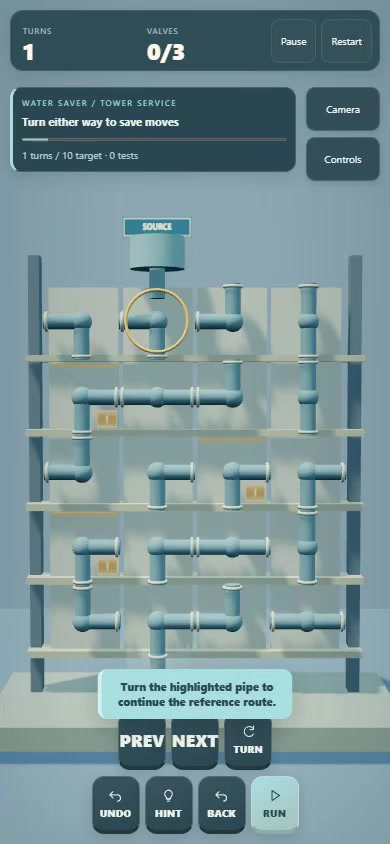
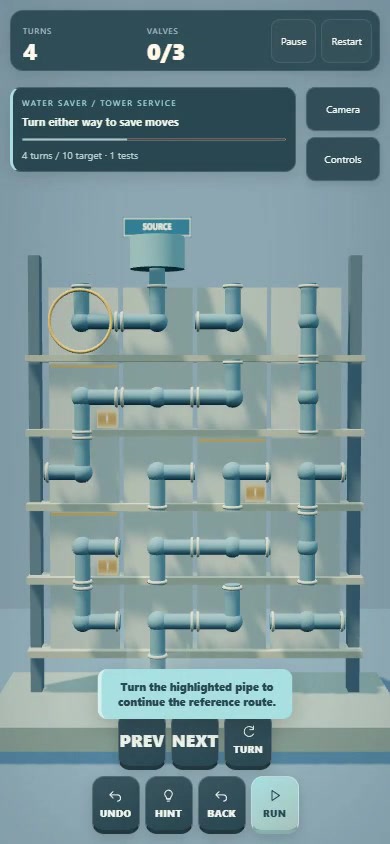
Tap a pipe to rotate it clockwise. For button or keyboard control, PREV and NEXT select a position, while TURN or Space rotates the selected piece. BACK or Q turns it anticlockwise. This is particularly useful when a piece needs only one reverse turn: there is no reason to spend three clockwise moves achieving the same orientation.
UNDO or Z restores the previous turn and reduces the recorded turn count. You can use it to reverse an experiment without rebuilding the entire network. The camera switches between front and angled views, helping you inspect the board from a useful perspective. Before testing, trace each connected opening from the source and make sure the route includes the gold V markers.
Water tests explain the mistake
RUN or R sends water through the current layout. The game follows the route and colours visited pipes as the test progresses. A failed test can reveal an inlet that does not connect, an open end outside the tower, a closed end or a loop. Even a route that reaches the reservoir fails if it skips a required valve.
After a leak, you return to editing with your arrangement intact. The failing pipe is selected and the game reports the problem, so the test offers a location to investigate rather than forcing a fresh start. Repair that point, then check how the change affects the next connection. A local fix is useful only when it still belongs to a valid route through the remaining board.
From a working route to Water Saver
HINT or H highlights a correction on the game's reference route. It is a directional aid rather than an automatic solve, and using it caps the star award at two. The highlighted piece still needs to be rotated by the player. This is useful when you have lost track of the route, but it changes the goal of that attempt.
For the Water Saver seal, finish on the first water test, without hints, and at or below the displayed two-way turn target. That target accounts for efficient rotation in either direction. The same unassisted first-test efficiency earns three stars. A completed route can still be worthwhile without the seal: it gives you a concrete layout to understand before attempting a more economical solution.
Why a visible test feels rewarding
My analysis of the design is that the flowing water makes an abstract connection problem tangible. Before RUN, the solution exists as your prediction of how openings join. During the test, that prediction becomes a visible sequence. Watching the flow travel through the valves and into the reservoir provides a clear payoff for careful planning rather than merely displaying a success message.
Preserving the board after a leak also supports focused experimentation. You can compare the failed route with the repair instead of trying to remember a discarded layout. Meanwhile, the first-test seal creates a separate challenge for players who enjoy solving mentally before acting. These interpretations come from the current rules; they are not a statement of undocumented developer psychology or a promise about how every player will respond.
A useful first-run routine
Start at the source, identify the required valves and work toward the reservoir one connection at a time. Leave unrelated pieces alone unless your route needs them. Check whether BACK saves turns before committing to repeated clockwise rotations. On an exploratory run, use a water test to learn from a leak; on a seal attempt, inspect the entire route before pressing RUN.
Where to play
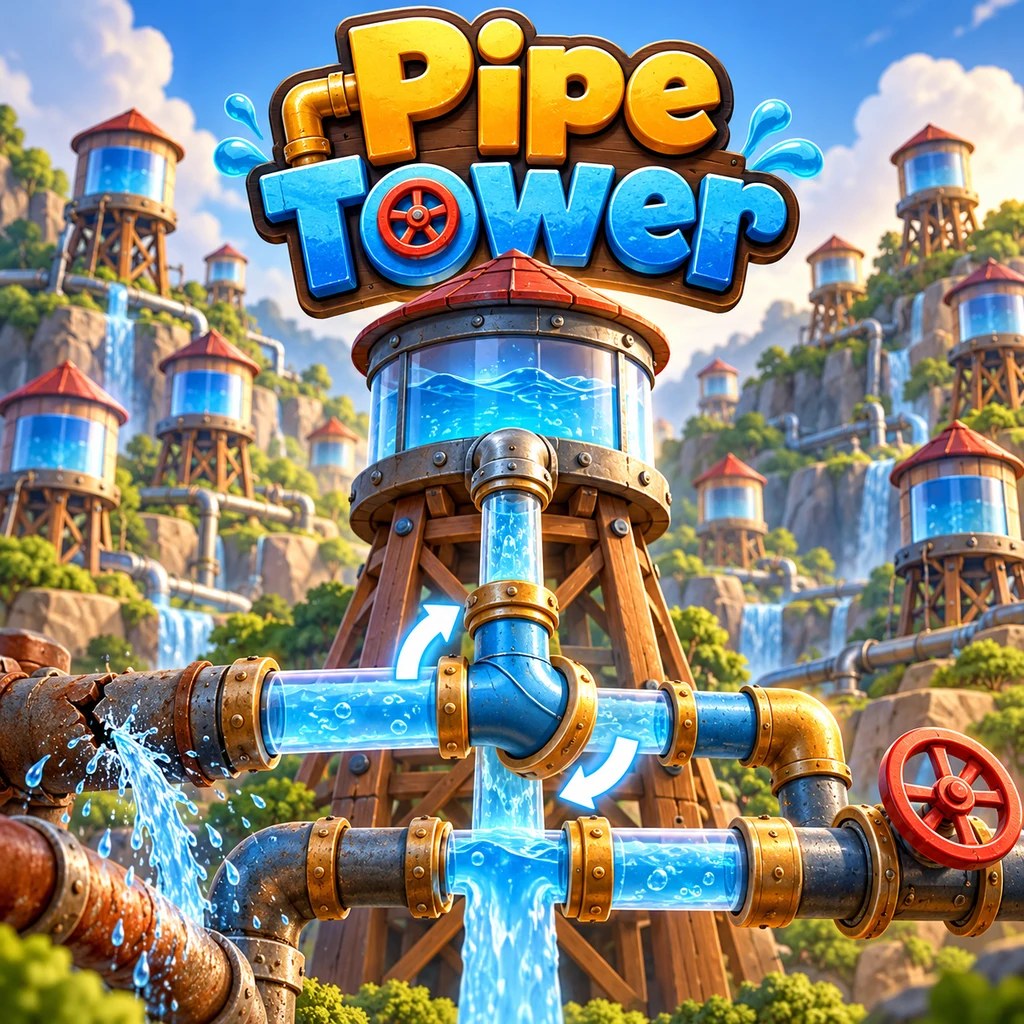
Play Pipe Tower on Oppoz through the verified link below. The linked current game and official preview provide primary references, and the gallery shows real editing states from that preview. The stylized cover is promotional art, not a gameplay capture. Matching CrazyGames, Playgama and Google Play releases remain unverified; this article does not imply that unsuccessful searches prove their absence.
Inside the game