
Pocket Golf Lab: predict the roll before committing to the putt
Twenty-four island greens combine adjustable power, a visible shot prediction and Clean Card goals for careful rounds.

A small green with a visible question
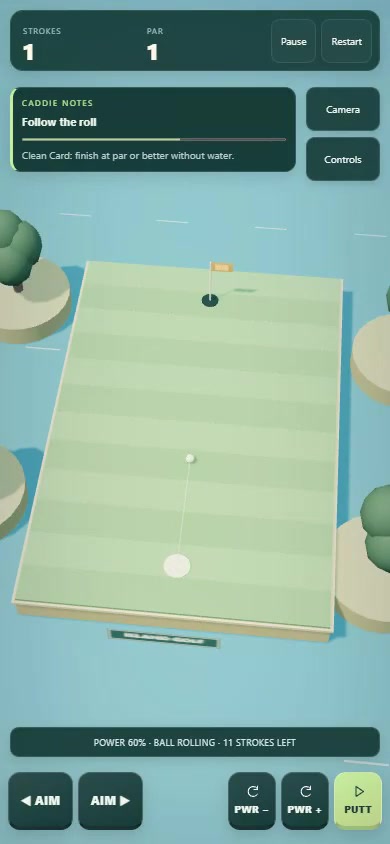
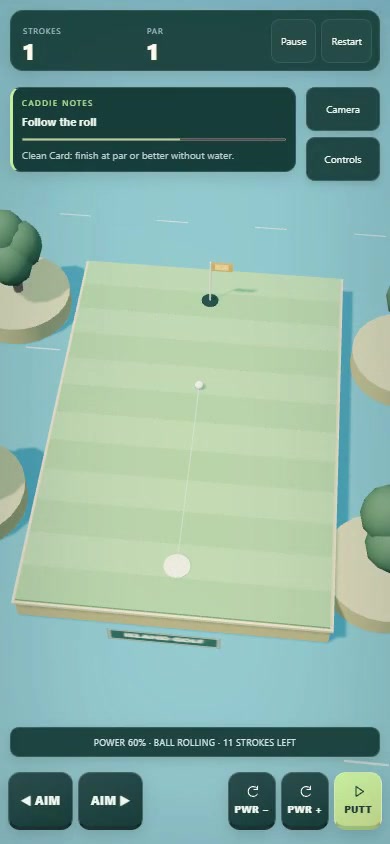
Pocket Golf Lab places a ball on an island green and asks you to find a route to the cup. Before taking a shot, you can inspect a predicted path and an endpoint ring. That turns each putt into a small question: will this direction and power leave the ball somewhere useful? The answer becomes visible when the ball rolls, rebounds or slows, giving the next decision a concrete starting point.
The current game contains twenty-four greens. Early holes provide room to learn the relationship between power and distance, while later layouts introduce walls, sand, water and bumpers. Those features change what a useful shot looks like. A straight line toward the flag may be blocked, and a successful approach may depend on leaving a clear second shot rather than aiming directly at the cup immediately.
Two ways to set up a shot
On touch or with a pointer, drag backwards on the green and release to putt. The drag sets direction and power; you do not need to begin precisely on the ball. Alternatively, hold the aim arrows, adjust power using the minus and plus buttons, then press PUTT. Keyboard controls use left and right arrows for aiming, 1 and 2 for power, and Space to take the shot.
The displayed power and prediction update as you adjust your setup. A camera option provides an overhead view, which can help when judging the relationship between a wall and the cup. Wait for the ball to stop before preparing the next putt. Start with small adjustments, especially near a hazard: changing both direction and power dramatically makes it harder to understand which choice caused the resulting roll.
Read the path, not just the endpoint
The ring estimates where the ball will finish, and a peach-coloured prediction warns of a lost ball. Inspect the whole path as well as that final marker. A route may rebound from a wall, pass through sand or approach water before reaching its endpoint. A promising final position is useful only when you understand how the ball is expected to get there.
Sand slows the ball more strongly than the normal green. Walls and bumpers redirect it, while water and the edge of the island can lose the ball. A water penalty adds an extra stroke and returns play to the previous shot position. That reset lets you reconsider the same problem, but it does not erase the cost. A safer line can therefore be preferable even when it takes an additional deliberate approach shot.
The cup rewards controlled speed
Reaching the cup's area is not the same as arriving at a useful speed. A hard shot can pass the target, while a gentler putt can settle into it. Use the preview to reduce guesswork, then watch the actual roll. Near the hole, consider lowering power before making a large change to the angle. Precision is often about removing excess movement rather than adding a more elaborate trajectory.
A useful first-round method is to divide a blocked hole into stages. Find a safe position beside or beyond the obstacle, then reassess the remaining line from there. Before shooting, check whether that stopping point leaves enough room for the next putt. The game has a twelve-stroke limit, so experiments are possible, but repeated unexamined attempts can consume the round without improving your position.
Clean Cards give a familiar green another goal
Finishing at par or better earns three stars, while finishing within two strokes above par earns two. The optional Clean Card requires par or better with no water penalties. That adds a specific reason to revisit a hole you have already completed. You are trying to combine an efficient route with a clean round, rather than merely proving that the ball can eventually reach the flag.
On a replay, choose one part of the previous round to improve. Perhaps the first shot stopped too close to a wall, or a rebound left a difficult angle. Adjust that decision and observe the difference. Keeping the rest of your approach familiar makes the effect easier to judge. The visible shot trail also helps connect the chosen setup with what the ball actually did on the green.
Why predicting the roll is part of the fun
Our reading of the design is that the preview creates a useful connection between intention and outcome. You make a prediction, commit to a shot and watch it unfold. Hazards keep that process interesting, while adjustable power provides room for fine corrections. Clean Cards reward a complete, careful plan. These are observations about the implemented mechanics, not claims of documented developer intent or measured psychological benefits.
Play the verified release using the Oppoz link below. The gallery contains real frames from the official gameplay preview; the cover is promotional artwork. Searches across CrazyGames, Playgama and Google Play did not establish matching external listings for this exact game. Those releases remain unverified, so the Where to play section includes only the confirmed destination.
Inside the game