
Ramp Landing: reaching the platform is only half the jump
Set launch power, read the predicted range and level the car in flight across twenty-four stunt challenges.
Two problems in one short flight
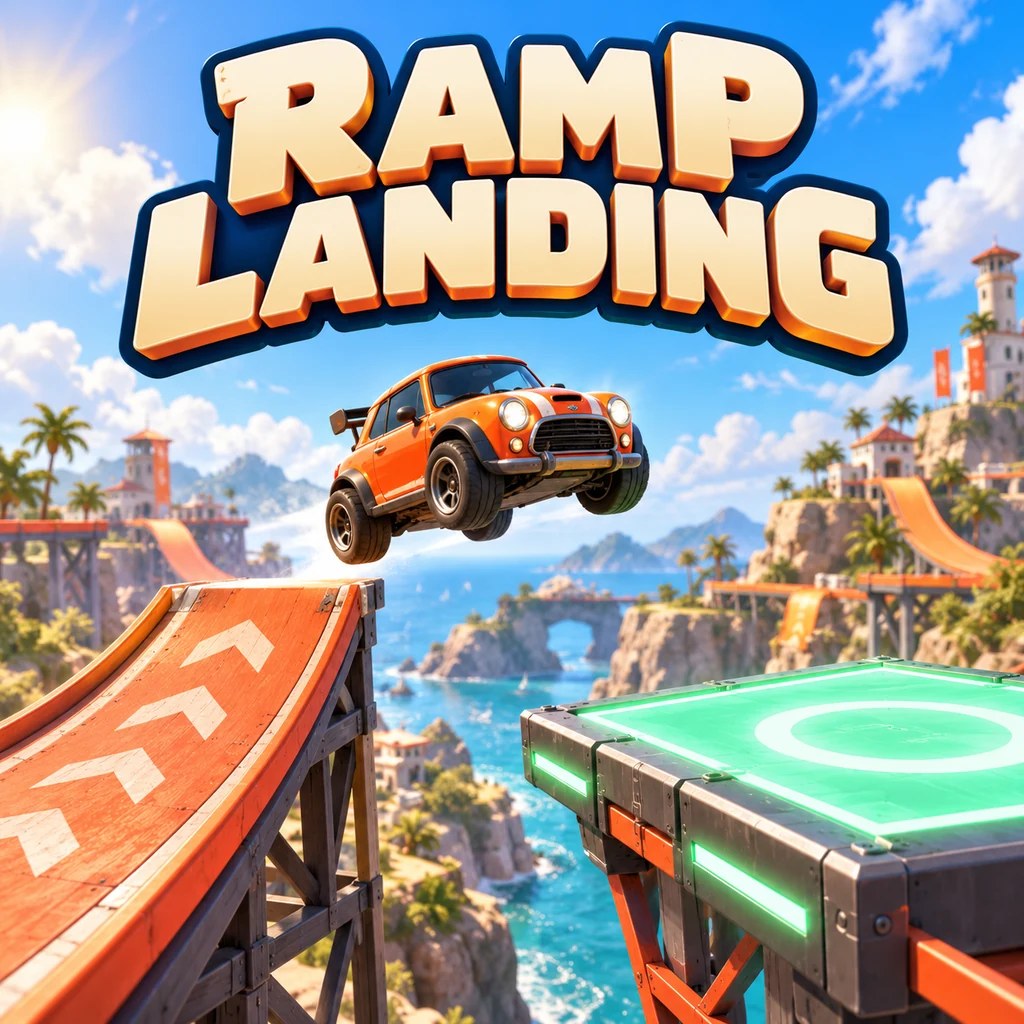
Ramp Landing sends a car off a ramp toward a raised mint platform. The challenge has two parts: choose enough launch power to reach the landing area, then control the car's pitch so the wheels meet it at a safe angle. A jump can cover the correct distance and still fail because the nose is poorly aligned at touchdown.
The current release contains twenty-four challenges. Ramp angle, wind and the landing zone change across the set, while later challenges tighten the acceptable landing area and angle. The short flight makes each attempt easy to read. You can usually separate a range mistake from an attitude mistake, which gives the next attempt a specific problem to solve rather than a vague instruction to try harder.
Set the range before pressing LAUNCH
Before taking off, use POWER minus and plus, or keyboard keys 1 and 2, to adjust launch strength. LAUNCH or Space commits the car to the run-up. The interface shows estimated range, target distance and wind, with a marker indicating the expected landing position. Compare that estimate with the mint platform before starting the jump.
Do not carry a power setting from one challenge into the next without checking the prediction. A different ramp angle or wind changes the relationship between the setting and the distance travelled. Start by bringing the range inside the landing area. Once you can reach it reliably, refine the setting toward the middle instead of accepting a landing that barely catches an edge.
Level the car while it is airborne
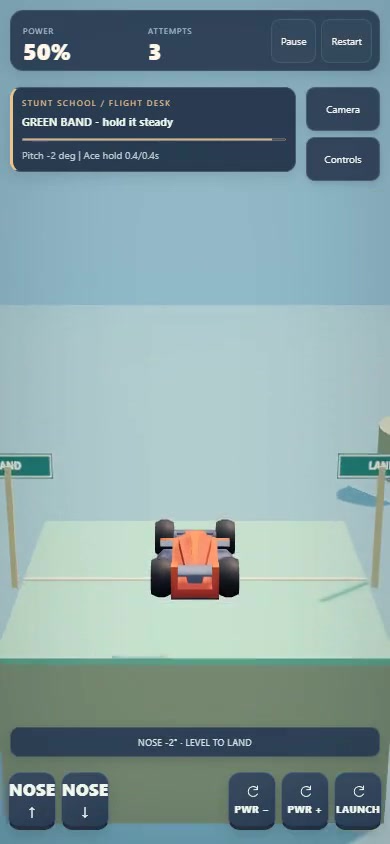
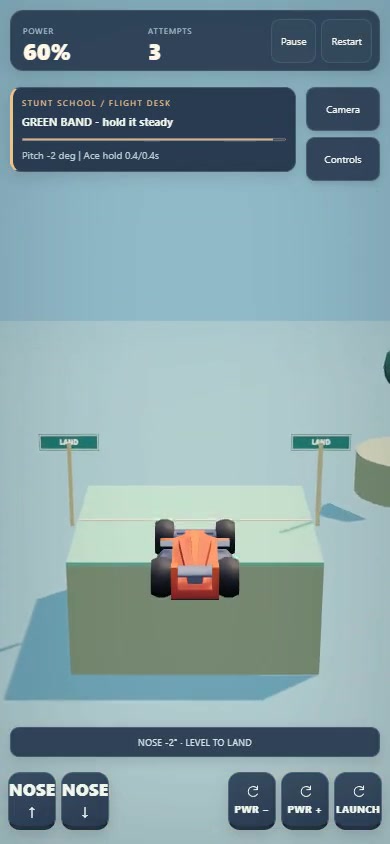
In flight, hold NOSE UP or NOSE DOWN, using the left and right arrow keys on a keyboard. These controls adjust pitch rather than launch power. Watch the displayed angle and the car's orientation as the platform approaches. A brief correction early enough to settle can be easier to manage than a large correction just before contact.
The flight desk reports whether the nose is inside a tighter green band. When the angle becomes useful, ease off the input and observe whether it stays there. Constantly alternating both directions can turn a small error into an oscillation. Use the side or chase camera view that makes the landing easiest for you to judge, and keep it consistent while learning a particular jump.
Read the failure before changing the setup
Each challenge gives you three attempts. A short landing calls for more power, while overshooting calls for less. Reaching the platform with the wrong angle calls for a different pitch correction. The game supplies feedback for these cases. Changing power after an angle failure may make the next attempt worse by disturbing a part of the jump that was already working.
A useful practice sequence is to establish the range first, then concentrate on the final angle. After a successful landing, look at accuracy rather than assuming every success is equivalent. A landing closer to the platform's centre scores better. On the next try, change one decision and watch its effect so that the improvement remains connected to something you can deliberately repeat.
Ace Approach rewards a stable finish
The optional Ace Approach requires a first-attempt landing with at least eighty-five percent accuracy and the nose held inside the tighter green band for the final four-tenths of a second. It is more demanding than simply touching down successfully. A late rescue that reaches a safe angle at the final instant may finish the jump without earning that additional recognition.
That goal gives the flight a different emphasis on replay. You are trying to settle the car before the final moment, leaving enough time for the stable interval to count. The displayed hold progress helps you see that distinction. First learn to finish the jump, then pursue a centred landing, and finally combine accuracy with a calm final approach on the first attempt.
Why a controlled landing is satisfying
Our reading of the design is that the range preview and pitch feedback make a spectacular action understandable. The launch creates commitment, while the airborne controls leave a small but meaningful opportunity to influence the result. Watching a car settle onto the platform turns an abstract power setting into a visible achievement. This is analysis of the mechanics, not a claim about developer intent or real-world stunt training.
Play through the verified Oppoz link below. The gallery uses actual frames from its official preview, alongside promotional cover art. Specific searches on CrazyGames, Playgama and Google Play did not establish a matching external release for this portfolio game. Those platforms remain unverified for this title, rather than being declared unavailable based on search results alone.
Inside the game