
Sakura Slice: one flip, a flying blade, and a nine-times combo
Guide a rotating katana through bamboo, lanterns, and scrolls. Sakura Slice turns a single flip button into a challenge of height, timing, and controlled risk.
You control the next arc
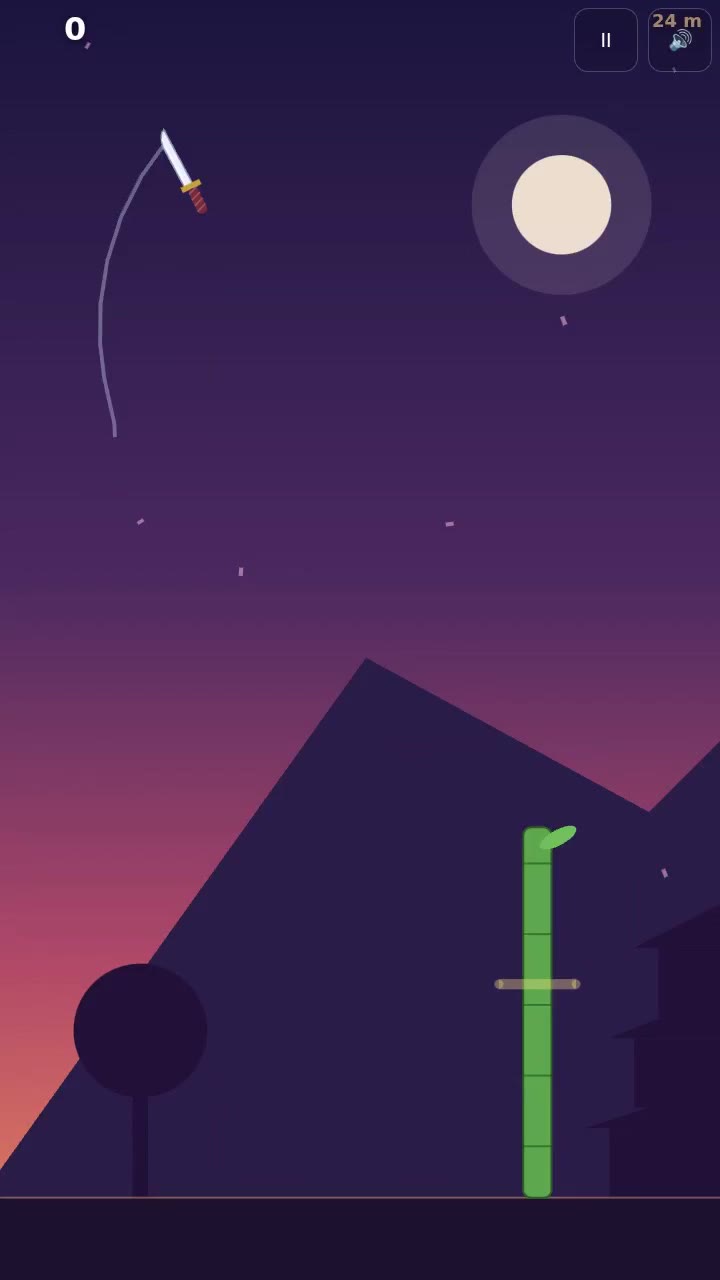
Sakura Slice places a flying katana in a dusk courtyard. The blade travels forward automatically, while a single action sends it upward and increases its spin. Bamboo, lanterns, and scrolls appear along the route. Your job is to meet them at a useful height, ideally crossing the glowing target band for a perfect cut instead of merely brushing past.
The verified Oppoz version combines a distance counter with a score and combo display. Those measures encourage different kinds of attention. Staying in motion carries you farther, but collecting points asks you to place the blade deliberately. A run can be safe and unproductive if every flip takes the sword high above the objects you wanted to slice.
How to play: tap to flip
Press Space or click on desktop; tap the play area on touch devices. Each flip gives the blade an upward kick and a stronger rotation. Gravity then pulls it down again. The input does not ask you to aim a swipe across the target. Instead, you choose when the next arc begins and let that decision bring the moving blade into contact with the object ahead.
Try watching the nearest object’s height before pressing again. Repeating the action as quickly as possible can keep you away from the useful part of the screen. A short pause lets the blade descend; another flip changes that descent into a fresh climb. Learning that relationship is more valuable than trying to memorise a fixed tapping rhythm for every arrangement.
Perfect cuts make the route more interesting
The glowing bands distinguish precise cuts from ordinary contact. Perfect cuts can build a combo up to nine times, making the height of an encounter matter to the score. Bamboo provides a tall object to intersect, while hanging targets ask you to meet a more specific area. The next flip can therefore be a scoring decision as well as a movement decision.
Touching the ground does not immediately end the run. The current source makes the blade bounce and resets its combo. Stone has a different consequence: colliding with its solid core shatters the blade. That distinction matters. Dropping a multiplier is a setback you can recover from; ignoring a stone obstacle can remove the chance to recover at all.
Why the simplicity has room for skill
One input gives the game a compact vocabulary, but its consequences unfold over time. Your current height, vertical motion, rotation, and the approaching target all affect what the next press achieves. Seeing a clean cut after leaving the button alone for a moment can be as satisfying as making a fast correction. Restraint becomes an active part of playing well.
My interpretation of the design is that the safe floor bounce separates learning from complete failure. You can lose a scoring chain and continue practising, while stone provides a clearer survival boundary. The visible bands make precision easy to recognise. These are observations about the current mechanics, not documented statements of developer intention or promises about how every player will respond.
Make the first goal a clean encounter
Start by trying to meet one bamboo band at a deliberate height. Notice whether the last flip carried you above it or whether waiting left the blade too low. Change one part of the timing on the next encounter. Once those adjustments feel understandable, preserving a combo offers a more demanding reason to read several objects ahead instead of reacting only to the nearest one.
The browser build stores best score and best combo, so you can distinguish a long journey from a stronger scoring run. The gallery shows genuine blade-flight frames from the official Oppoz preview, labelled with their capture times. Use the verified play link below to try the courtyard. The useful question before each flip is simple: what do you want the blade to meet next, and at what height?
Inside the game