
Tilt Temple: Collect the Runes, Then Learn to Stop
A floating temple, three rune checkpoints and a slow-entry gate make careful braking as important as choosing a route.

A marble trial built around momentum
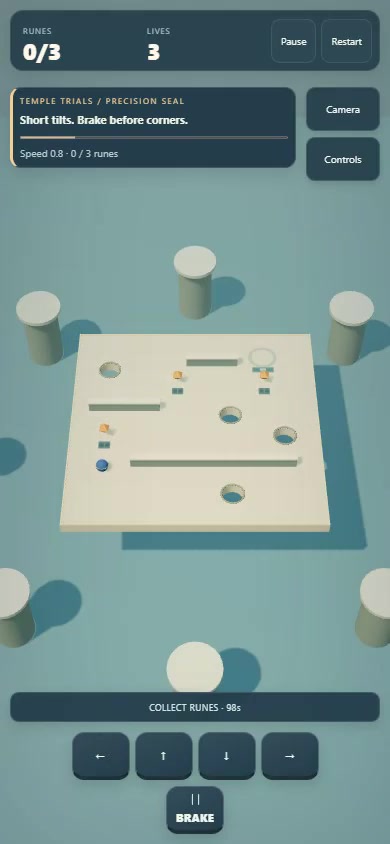
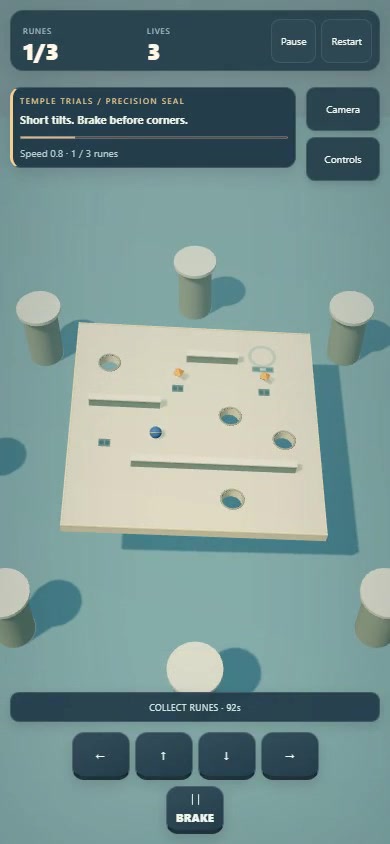
Tilt Temple places a blue marble on a floating stone board filled with low walls, open pits and three collectible runes. Your goal is to gather every rune and settle inside the gate. Getting close to the exit is not enough: the gate requires a controlled, slow arrival. That final condition makes the whole journey a lesson in managing motion rather than simply pointing toward the next object.
Across 24 trials, the board changes orientation and arrangement, with variations in pit size and the time available. The visible layout gives you room to plan, but the marble does not move like a cursor. It accelerates while you tilt and keeps some momentum after you release. A route therefore has two parts: where you want to go and how you will slow down when you get there.
How to tilt without a motion sensor
Drag on the board to tilt it, or hold the arrow keys or on-screen arrow buttons. Releasing the drag levels the board; it does not instantly stop the marble. Hold BRAKE or Space for stronger slowing. No phone motion sensor is required, so the central interaction works through ordinary touch or keyboard input.
Start with a short movement toward the first rune, then release and watch how far the marble continues. Brake before the corner rather than waiting until you are beside a pit. The game also offers top and angled camera views. Use the view that makes the upcoming gap easiest to read, especially when a wall or a rune marker makes your intended line less obvious.
Runes provide progress and recovery
Each collected rune also saves a checkpoint. If the marble falls through a pit or over an open edge, you lose a life and return to the latest saved rune position, keeping the runes already collected. Three falls end the trial. This gives you a chance to practise a difficult section without immediately repeating the entire board, although the trial timer continues to matter.
The walls are obstacles that can redirect the marble; they are not substitutes for braking. Hitting one may leave you moving in a direction you did not intend. Before taking a narrow passage, look beyond it for a safe area to slow down. A checkpoint is useful insurance, but deliberately relying on falls prevents the clean completion needed for the strongest result.
The gate rewards a calm approach
After all three runes are collected, the gate becomes available. Approach it at low speed and let the marble settle inside. Flying through the gate's position can leave the trial unfinished because the game checks both your location and your speed. If you overshoot, reduce your motion first, then make a small correction instead of adding another large tilt.
Three stars require completing the board with all three lives. The precision seal adds a faster target: a clean completion in under 60 seconds. These goals work best as successive challenges. First learn how to reach every rune without a fall; then improve the route and reduce unnecessary movement. Trying to chase the timer before understanding stopping distance often creates extra corrections that cost more time.
Why restraint can feel rewarding
Our design interpretation is that Tilt Temple makes anticipation visible. A successful turn reflects a braking decision made before the marble reaches the danger, so improvement is not only about faster reactions. You begin to recognise how long a small tilt lasts and how early to release. This is analysis of the implemented mechanics, not a claim about an undocumented developer intention.
The checkpoints split a larger route into manageable sections, while the slow-entry gate gives the run a different final rhythm. Collecting the last rune is a moment of progress, but the task still asks you to regain control. That change from travelling to settling can make the finish satisfying: the board is complete because you brought the marble to the right state, not merely the right vicinity.
A practical habit is to think in short phrases: accelerate, coast, brake, correct. Near open edges, shorten each phase. On a clear stretch, let the motion carry you instead of continually adding tilt. The fun comes from gradually turning a sequence of anxious corrections into a controlled route whose stopping points you can predict.
Where to play
Tilt Temple is verified live on Oppoz through the link below. We have not verified matching releases on CrazyGames, Playgama or Google Play for this exact portfolio game. Its gallery contains genuine frames from the official Oppoz preview, while the separately labelled cover is promotional catalogue artwork.
Inside the game