
Tower Balance: Stack for the Weight, Then Survive the Wind
Eight unevenly weighted blocks make a rooftop tower puzzle where the safest placement is not always visually centred.
Eight blocks and a final weather test
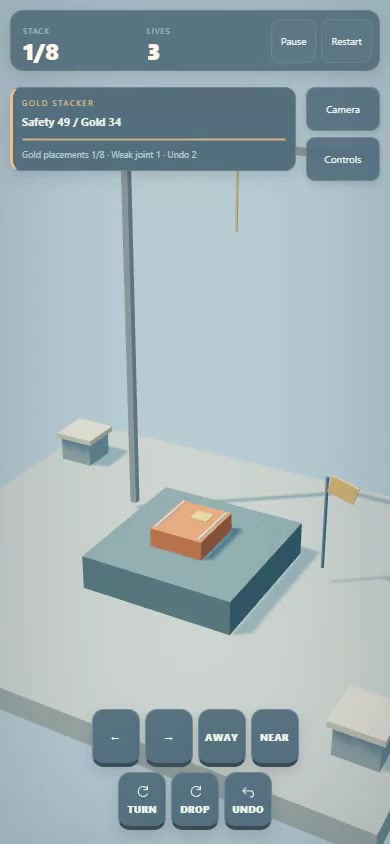
Tower Balance asks you to stack eight blocks on a small rooftop base and keep them standing through a four-second storm. The pieces differ in size, mass and the position of a heavy metal insert. A block that looks neatly centred can still load the tower unevenly. The challenge is to balance the combined weight through every supporting contact, not simply align the visible edges.
The game offers 24 challenges with different block arrangements, wind strength and gold safety targets. It uses simplified load-balance rules rather than a full rigid-body simulation. That makes the forecast and weight markers central to understanding the puzzle: they explain the support problem the game is evaluating, even when a stack's visual silhouette looks reassuring.
Position and turn the suspended piece
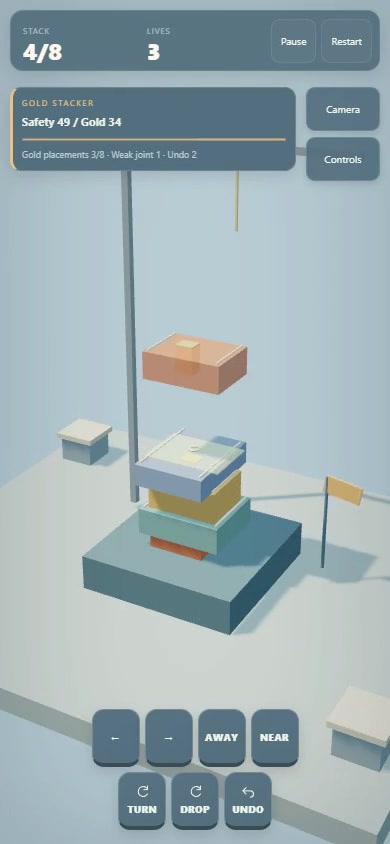
Use the arrow controls to move the suspended block in small steps. TURN or R rotates both its footprint and its heavy insert. DROP or Space lowers it onto the stack. Before dropping, compare the new block with the one below and watch how moving or turning it changes the safety reading. A rotation can alter the useful overlap as well as the direction of its extra weight.
The gold insert identifies the heavy side. The pale ring marks the projected weight centre in calm air, while wind shifts the effective loading. These are complementary clues rather than interchangeable guarantees. A calm-air centre that appears acceptable does not mean every contact will remain supported when the forecast wind acts on the upper blocks.
The weakest contact controls the result
The safety forecast reports the smallest predicted support margin through the full wind forecast. It also identifies the weakest joint. Pay attention to that joint rather than assuming the newest block is always the problem. Adding weight at the top changes the load carried through lower contacts, so a placement can expose a weakness several layers beneath it.
A red forecast indicates likely collapse. A positive margin means the predicted loading remains within support, but the gold target asks for a stronger result. The displayed safety score is therefore useful as more than a binary permission to drop. Try small position changes and compare the margin, then keep the arrangement that gives the tower more room to tolerate the weather.
Retrieval gives limited room to revise
UNDO or Z retrieves the last block, with two retrievals available per attempt. Using retrieval caps the result at two stars. If the tower collapses, it rebuilds from the beginning and consumes one of the three attempts for that challenge. The game can check stability while you are building as well as during the final storm, so an already unstable tower is not protected simply because you have not placed the eighth block yet.
After the final placement, the storm tests the completed stack for four seconds. A clean first attempt that meets the gold safety margin earns three stars. A surviving first attempt with a smaller safe margin or a retrieval earns two, while success after a collapse earns one. Finishing the structure and building a gold-safe structure are different achievements.
Build strength throughout, not only at the top
The Gold Stacker seal requires at least six placements to meet the gold margin, a gold-safe final tower, and no retrieval or collapse. This rewards a consistently sound construction process. It is not enough to create an unstable-looking sequence and hope the last block happens to compensate for everything below it.
Our design interpretation is that the heavy inserts make appearances an incomplete guide. Players must connect an object's visible shape with its less obvious weight distribution, then consider the whole stack rather than a single layer. The forecast turns that reasoning into readable feedback. This is analysis of the implemented systems, not a statement about an undocumented developer intention.
A useful routine is to inspect the insert, try the alternate rotation and compare safety before committing. After each placement, check which joint is now weakest. If the weak point stays low in the tower, adding height without changing the loading strategy may make the problem harder. The fun comes from discovering that a slightly offset or rotated piece can create a more secure structure than a visually tidy stack.
Camera changes the viewing angle so you can inspect depth as well as width. Use it when two edges overlap in the current view, but keep the numerical forecast in the decision. The final storm is most satisfying when it confirms a structure you understood while building, rather than delivering a surprising pass or failure.
Where to play
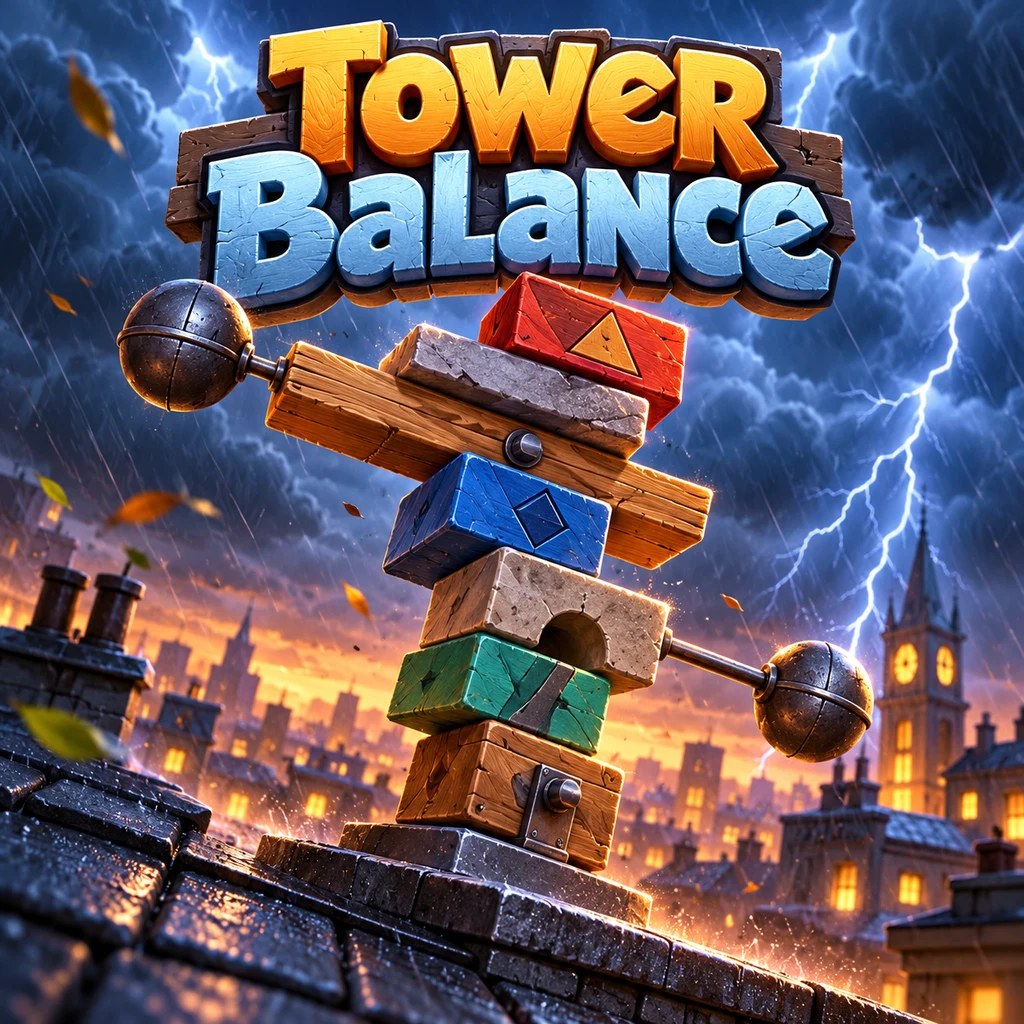
Tower Balance is verified live on Oppoz using the link below. Matching releases on CrazyGames, Playgama and Google Play remain unverified for this exact portfolio title. The two screenshots are genuine frames from the official Oppoz preview. The cover is promotional artwork and is labelled separately from gameplay.
Inside the game