
Traffic Pulse: Read the Gap, Commit to the Crossing
Three traffic lanes, safe islands and a limited Focus ability turn a courier route into a test of timing and restraint.
A delivery route measured in decisions
Traffic Pulse puts a small courier vehicle at the edge of a three-lane road and asks a deceptively simple question: when should you cross? Moving traffic separates the starting point from the delivery destination. Striped islands between lanes provide places to stop, observe and prepare the next movement. The route is short, but every departure exposes you to cars that keep moving while you commit to your crossing.
The game contains 24 challenges. Early shifts ask for three deliveries, with later groups increasing the requirement to four and then five. Traffic also becomes faster as you progress. You have three lives and a 90-second shift, so neither reckless rushing nor waiting indefinitely solves the problem. The challenge is to make a sequence of sensible decisions quickly enough to complete the work.
How to play: one lane at a time
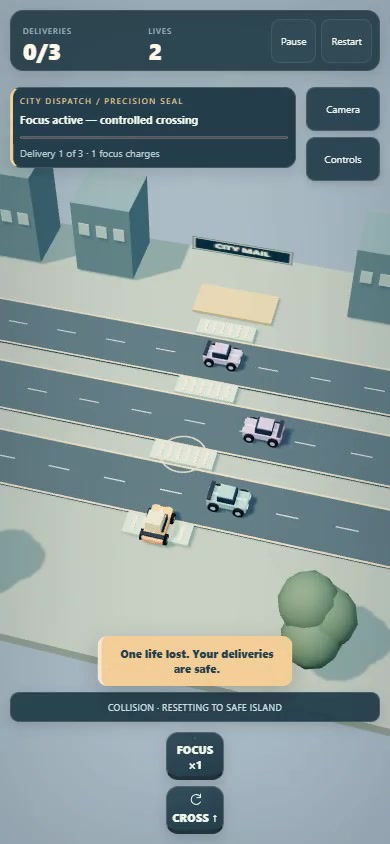
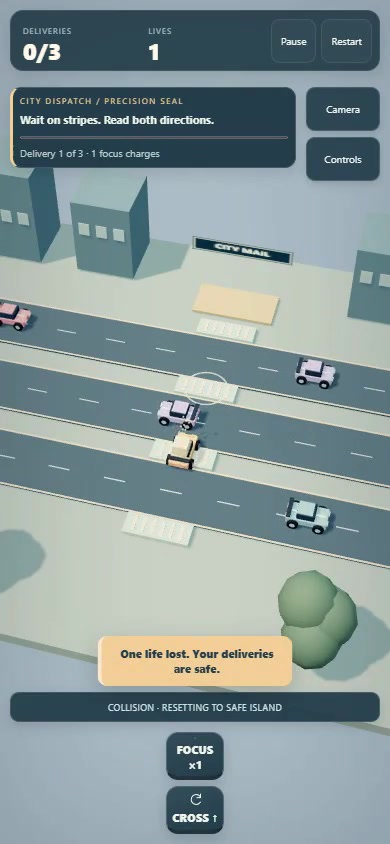
Use the on-screen CROSS button or press Space to advance to the next island. A crossing is a committed movement rather than a freely steered drive: once you start, you cannot simply weave around a vehicle midway through it. Let the current lane become readable before pressing again. Reaching the far side completes a delivery and returns you to the starting side for another run.
Watch each lane separately. The middle lane flows in the opposite direction to its neighbours, so copying the timing of your previous crossing is unreliable. A collision removes a life and resets you to your current safe island. Already completed deliveries remain recorded. That makes recovery possible after a mistake, although a third collision ends the attempt. The optional camera view can help you inspect the road from a different angle.
What Focus actually changes
FOCUS, also available with F, gives you two charges per shift. Each activation slows the moving simulation for three real seconds. Crucially, it slows your courier as well as the traffic. It is a tool for reading movement and controlling the decision, not a guarantee that an unsafe gap becomes safe. The shift clock continues to run, so the extra thinking time still has a cost.
This distinction is useful when learning. Activate Focus before committing if you need a clearer view of a lane, then watch where the approaching vehicle will be during the crossing rather than judging only its position now. Once you understand the pattern, try the same crossing without assistance. The precision challenge rewards a three-star finish with both Focus charges unused, giving experienced players a reason to refine their observation.
A practical approach to the shift
Begin by treating each striped island as a new starting point. After reaching one, look at the next lane's direction and spacing before issuing another command. Avoid turning the CROSS button into an automatic rhythm: the courier's movement may repeat, but the traffic positions do not reset simply because you reached safety. A short deliberate pause can prevent the longer disruption of a collision.
Then work on finishing efficiently without spending lives. The strongest star result requires all three lives and completion before 70 percent of the shift limit has elapsed. This asks you to improve the quality of your timing, not just survive by waiting. If you lose a life, use the remainder of that attempt to understand the gap that fooled you; the retained deliveries let you keep practising the route.
Why the stops make the action engaging
Our design reading is that the islands create alternating periods of observation and commitment. You get a moment to form a prediction, followed by a crossing that tests it immediately. That connection between a visible choice and its outcome can make improvement feel understandable. This is an interpretation of the implemented rules, rather than a claim about an undocumented developer intention.
The limited Focus charges add a second decision: whether to spend help now or preserve it for a later lane. Meanwhile, the timer discourages endless hesitation. Together these systems give a compact road scene more depth than its small control set suggests. The satisfying moment is a clean delivery built from three well-read gaps, followed by the confidence to do it again.
Where to play
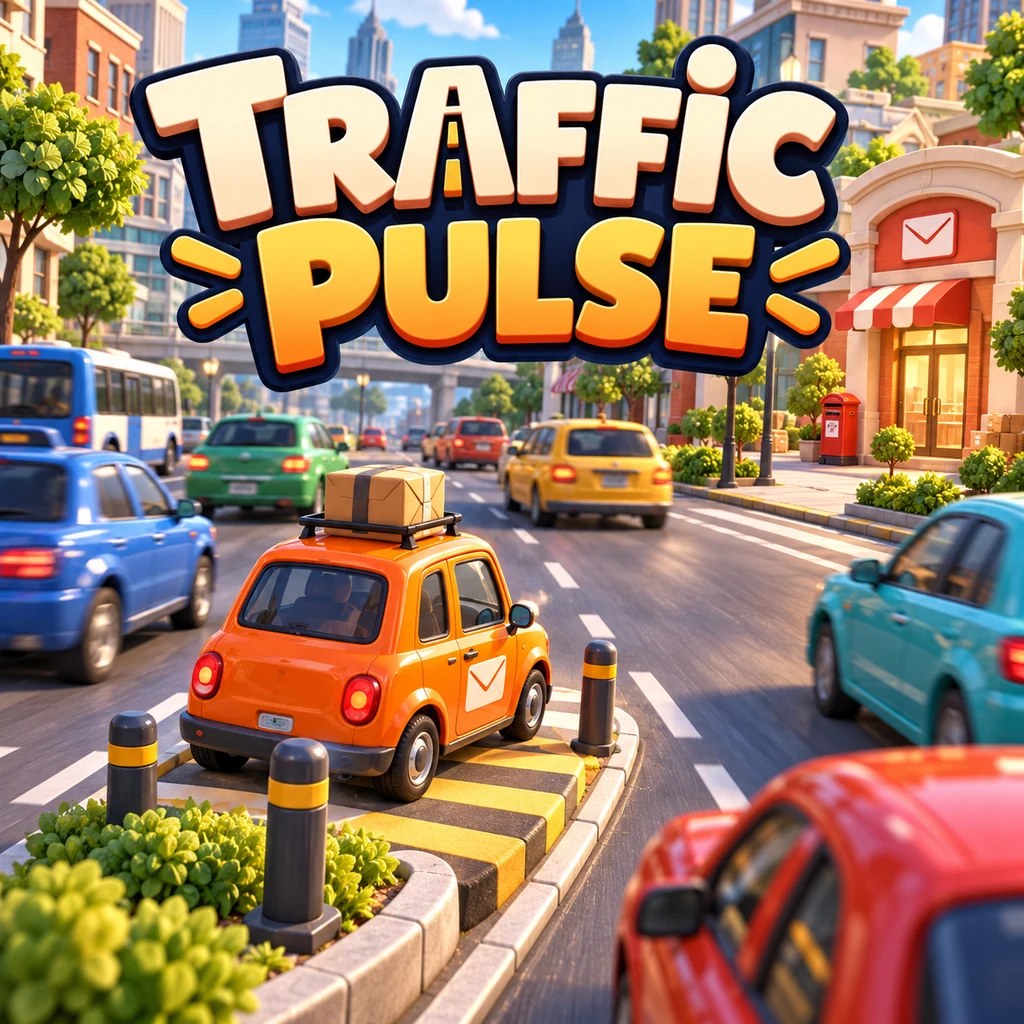
Play Traffic Pulse on Oppoz using the verified link below. This article covers the current browser release. Matching releases on CrazyGames, Playgama and Google Play were not verified for this exact portfolio game, so no external store availability is claimed. The gallery shows genuine frames from its official Oppoz preview; the cover is promotional artwork.
Inside the game